The International Office for Human Rights Action on Colombia

Colombia: Challenges in the Relationship between Business and Human Rights

A publication by OIDHACO detailing a number of emblematic cases within the context of business and human rights.

Colombia, traversed from south to north by three Andean mountain ranges, with the Pacific Ocean to the west and the Caribbean Sea to the north, the plains to the east and the Amazon rainforest to the south, has a geographical diversity and an exceptional wealth of natural resources throughout its territory, which stretches across mountains, glaciers, oceans and rivers, jungles, plains and moors

Complaint against the Spanish multinational Prosegur

On March 17, the Spanish MEP Raul Romeva i Rueda made a parliamentary question to the European Commission regarding complaints received on possible actions against trade unionists by Prosegur, a Spanish private security company.

According to a complaint received by the Colombian National Union School (ENS), the Compañía Transportadora de Valores Prosegur, a Spanish multinational, is allegedly threatening and buying off workers to get them to waive their rights under the collective agreement and renounce their trade union and instead to subscribe to a Collective Pact proposed by the company.

Hearings IACHR extractivism and Human Rights in Latin America – specific case of mining in Colombia

Summary of the two November 2013 hearings.

In a first hearing, the petitioners, who were present and had come from all over Latin America, expressed their concerns with regard to a new topic at the IACHR: the responsibility of States, including the home countries of the companies, as well as of the countries where the events occur. The second hearing analysed specifically the issue of extractive industry in Colombia.

The European Parliament must fulfill its promise to ‘use’ the FTA to demand improvements in human rights in Colombia

Press release on the hearing at the European Parliament on EU-Colombia Trade Agreement and Human Rights situation.

oday the European Parliament Sub-Committee on Human Rights has organised a hearing on the Situation of Human Rights in Colombia and the Free Trade Agreement (FTA). Oidhaco welcomes this initiative because the process of ratification of the FTA led to in-depth discussions on the human rights situation in the country. MEPs were alerted to the continuing violence in the region and the potential impacts of this Agreement in the various sectors of the Colombian economy.

Extractive industries, natural resources and human rights in Colombia

Summary of the multiple links between mining industry activities and human rights violations in Colombia. Joint document by the Colombian Platform for Human Rights, Democracy and Development and Oidhaco.

In recent years, there has been an intense debate in Colombia about the role of mining in the national development process. The country is experiencing a boom in mining activity. In a decade the coal mined in the country has almost doubled, from 38,242 million tons in the year 2000 to 74,350 million tons in 2010 ; in addition, the area of land given titles for mining has soared in recent years. In 2002 there were mining concessions over 1.1 million hectares, while in 2009, concessions had been awarded over 8.4 million hectares .

Development and responsible business practices – extractive industries in developing countries

Intervention by Sergio Coronado at the Development Committee of the European Parliament on the impacts of large-scale mining in Colombia, mainly in relation to human rights, poverty and environmental rights.

On September 17, 2013 the Development Committee of the European Parliament hold a hearing entitled “Promoting development through responsible business practices, including the role of extractive industries in developing countries” to which Sergio Coronado – Representative of the Colombian Platform for Democracy, Development and Human Rights*was invited in order to present the situation in Colombia.

National and transnational corporations and Human Rights – Declaration

Declaration signed up by more than 100 organizations on the occasion a Regional Forum on Business and Human Rights for Latin America and the Caribbean in Medellín.

On the occasion of the announcement made by the United Nations Working Group on Business and Human Rights, the Regional office for Latin America and the Caribbean (UNDP) and the Government of Colombia regarding a Regional Forum on Business and Human Rights for Latin America and the Caribbean to be held in the city of Medellín, Colombia, from 28 and August 30, 2013:

Mining in Colombia: Basics to overcome the extractive model

80% of the human rights violations occurring in Colombia, are taking place in the mining and oil municipalities. Main conclusions of the report; some reactions after its publication; and recommendations by Oidhaco.

In May 2013, the Colombian Comptroller General (Contraloría General de la República) published a report entitled “Mining in Colombia: Basics to overcome the extractive model” (Minería en Colombia: Fundamentos para superar el modelo extractivista) which was widely covered by the national press.

Civil Society in Brussels pronounce themselves in view of the First Summit between the EU and Latin America and the Carribean States.

“The networks in Brussels reiterate their call for a change of direction towards an equitable integration of peoples, and the emergence of a global financial architecture that protects the rights of citizens”

Brussels, 28 January 2013. The Heads of State and Government of the Community of Latin America and Caribbean States (CELAC), the European Union (EU), and the presidents of the European Council and the European Commission have agreed in Santiago de Chile, the 26 and January 27, 2013, to renew and deepen their strategic partnership, under the theme: “Partnership for development: Promoting Investments of Social and Environmental Quality. “

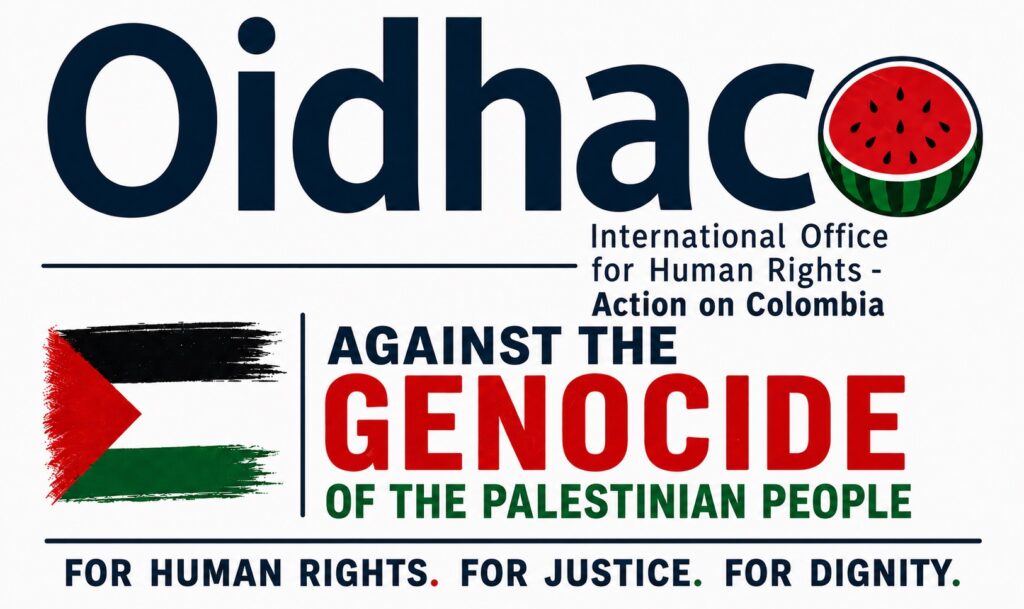
Our solidarity is universal.

We are deeply concerned about all victims of armed conflict, repression and violence around the world — from Sudan to Syria, including the persecution of the Rohingya and so many other crises that often receive less international attention than they deserve. Each of these situations calls for solidarity, remembrance, justice and action.

However, we have decided to specifically highlight the message ‘Stop Genocide in Palestine’ because what is happening in Palestine represents not only a human tragedy of enormous magnitude, but also a direct challenge to the fundamental principles of international humanitarian law and to the rules-based international system itself. The indifference and complicity of much of the international community in the face of the apartheid regime imposed by the Israeli government on the Palestinian people represent one of the greatest moral and political contradictions of our time.

The persistent violation of essential norms — such as the protection of the civilian population, the prohibition of collective punishment and respect for proportionality in the use of force — not only has devastating consequences for the Palestinian population, but also erodes the global mechanisms designed to limit the power of states and prevent abuses.

When these rules are repeatedly breached without any effective consequences, the framework that protects all populations in conflict situations, anywhere in the world, is weakened. Therefore, speaking out in this case does not mean ignoring other forms of suffering, but rather emphasising the urgency of defending an international order which, if it collapses, leaves everyone in a more vulnerable position.

Drawing attention to this situation is, therefore, an act consistent with the universal values we uphold: the protection of life, human dignity and respect for international law, without exception.

Oidhaco logo - Oficina Internacional de derechos Humanos - Acción Colombia
Privacy Overview

This website uses cookies so that we can provide you with the best user experience possible. Cookie information is stored in your browser and performs functions such as recognising you when you return to our website and helping our team to understand which sections of the website you find most interesting and useful.