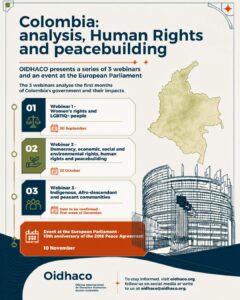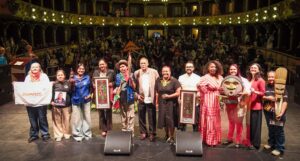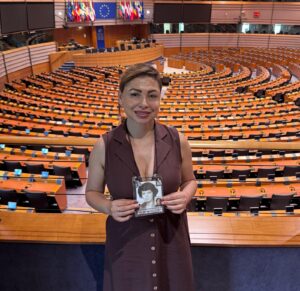
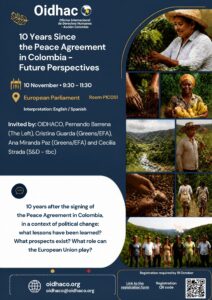
Event at the European Parliament to mark the tenth anniversary of the signing of the peace agreement in Colombia.
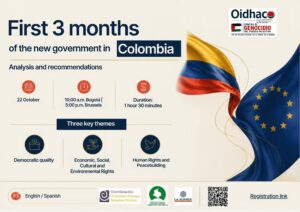
REGISTRATION IS OPEN until 19 October

REGISTRATION IS OPEN until 19 October

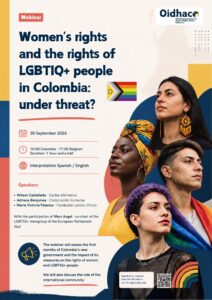
Webinar 30 September 2026

3 webinars and 1 event at the European Parliament (September–December) To stay informed, visit oidhaco.org, follow us on social media or write to us at oidhaco@oidhaco.org.

A new United Nations report warns of an increase in the recruitment of Colombians to take part in armed conflicts in other countries. Offers are mainly circulated via social media and through contacts with former members of the armed forces, with promises of high salaries and jobs in security or logistics. In some cases, those

Re: Securitization, militarization and its impact on human rights To the leaders of Latin America and the Caribbean and the European Union, As you gather in the forthcoming EU-CELAC ministerial meeting, security will be in everyone’s minds:security of your populations; international security in the context of a growing number of armed conflictsaround the world; as

Global Witness has published its new report, “Collective Power”, which documents the murder of at least 124 land and environmental defenders in 2025 and analyses the various forms of violence, criminalisation and threats faced by those who defend their land, communities and natural resources. In Colombia, Global Witness documented 39 murders of land and environmental

The Colombian National Human Rights Award has announced its 2026 winners, recognising the work of individuals, organisations and community initiatives committed to the defence of human rights, territories and peace-building. This year, the following were recognised: Yuly Andrea Velásquez Briceño, as Defender of the Year; the CRIC Women’s Initiative, as Grassroots Community Initiative; the Corporación

On 31 August 2026, the United Nations General Assembly adopted Resolution A/RES/80/301 without a vote, proclaiming 19 December as the International Day of Recognition for Women Searchers for Missing Persons. The resolution recognises the vital work of women who search for missing relatives and other missing persons, and calls on States and the United Nations

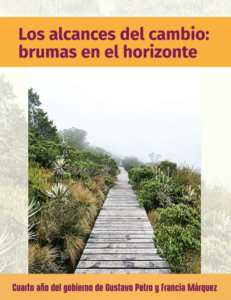
Four years into the administration of Gustavo Petro and Francia Márquez, this report covers a period marked by a promise of change that has brought long-overdue debates to the fore: inequality, peace, land, care, social justice, the environment and the rights of historically excluded communities. Spanish only

The International Office for Human Rights – Action on Colombia (OIDHACO) expresses its profound rejection and condemnation of the killing of María Ovidia Palechor, a Yanakuna Indigenous leader and human rights defender, and James Flor, a recognized peasant leader and victims’ representative, which occurred on 1 September in the district of La Pedregosa, municipality of
We are deeply concerned about all victims of armed conflict, repression and violence around the world — from Sudan to Syria, including the persecution of the Rohingya and so many other crises that often receive less international attention than they deserve. Each of these situations calls for solidarity, remembrance, justice and action.
However, we have decided to specifically highlight the message ‘Stop Genocide in Palestine’ because what is happening in Palestine represents not only a human tragedy of enormous magnitude, but also a direct challenge to the fundamental principles of international humanitarian law and to the rules-based international system itself. The indifference and complicity of much of the international community in the face of the apartheid regime imposed by the Israeli government on the Palestinian people represent one of the greatest moral and political contradictions of our time.
The persistent violation of essential norms — such as the protection of the civilian population, the prohibition of collective punishment and respect for proportionality in the use of force — not only has devastating consequences for the Palestinian population, but also erodes the global mechanisms designed to limit the power of states and prevent abuses.
When these rules are repeatedly breached without any effective consequences, the framework that protects all populations in conflict situations, anywhere in the world, is weakened. Therefore, speaking out in this case does not mean ignoring other forms of suffering, but rather emphasising the urgency of defending an international order which, if it collapses, leaves everyone in a more vulnerable position.
Drawing attention to this situation is, therefore, an act consistent with the universal values we uphold: the protection of life, human dignity and respect for international law, without exception.