The International Office for Human Rights Action on Colombia

‘Legal Framework for Peace’ – Amnesty for Human Rights violations committed by the different actors in the armed conflict

Short document presenting the constitutional reform on transitional justice.

The constitutional reform known as the ‘Legal Framework for Peace’ on transitional justice, adopted on June 19, 2012, includes the possibility of amnesty for human rights violations committed by the actors in the armed conflict (guerrillas, paramilitaries and state security forces), even in cases of crimes against humanity. “The central aspect of the present proposal focuses on the need for alternatives to criminal investigation, in order to make it feasible to prioritize the investigation of certain cases or to make it possible to forgo the criminal prosecution of others” (CCJ). This waiver of investigation and prosecution is in contradiction with international law.

The participation of women is essential to achieve lasting peace in Colombia

Debate in the European Parliament on the inclusion of women in the current Colombian peace talks. Joint press release by Oidhaco and Grupo Sur.

Thirteen years on since the signing of UN resolution 1325 on women, peace and security, a milestone for the recognition of women by the international community as essential actors for lasting peace, the civil society networks Oidhaco and Grupo Sur have organized today at the European Parliament in Brussels, an event in which women took the floor and explained to the EU why it is essential for them to be taken into account in the current negotiations being conducted by the Colombian government with the FARC guerrillas.

Peace in colombia will not be possible without the protection of rural community

Instead of fostering agro-industrial projects for export, the EU should rather give political and economic support to peasant initiatives”

This week marks international days for food, rural women, and eradication of poverty. Rural women are among the main victims of the conflict: 80% of the more than five millions of internally displaced persons are women, children and young people. Women are the main persons in charge of small-scale farming. But this has become more and more difficult, mainly due to land grabbing related to mining extraction and agro industrial projects, as well as to the dynamics of the armed conflict.

Oidhaco welcomes the start of peace talks in Colombia – and press releases of different organisations and institutions

The EU must accompany this process as well as supporting victims´ demands and Colombian civil society peace initiatives

Brussels, 4 September 2012. On a number of occasions OIDHACO has asked the EU to insist that instead of prolonging the war, Colombia channels all its efforts into achieving peace. We are convinced that the end of the armed conflict can not be achieved by military means, which on the contrary cause more pain and death every day, and which have already claimed thousands and thousands of civilian casualties over the past decades. For this reason, as a network of more than 30 European organisations, we welcome the decision of the Colombian government and the Farc guerrilla to begin peace talks.

Recommendations letter to the EU on Colombia

In 2010, Oidhaco sent a series of recommendations to the Spanish and Belgian Presidencies of the European Union, supported by some 90 European and international human rights organisations, development agencies, solidarity groups and church organisations. On 18th and 19th May 2011, the International Office on Human Rights Action on Colombia (Oidhaco) held its General Assembly, composed of 32 European and international organisations, and Colombian human rights coordination groups. We believe that the recommendations we made in 2010 (please find attached) are unfortunately still all too relevant this year, and so we attach them once again for your consideration

In August 2010 the new government in Colombia expressed a public commitment to the promotion and defence of human rights as a “profound democratic, ethical and human conviction”; promised to address the structural causes of poverty; and showed openness to the possibility of dialogue as a path to peace within Colombia. Civil society organisations in Europe and Colombia alike have been asking for these statements to be quickly translated into substantial, concrete and effective policies that will make a real difference in the lives of victims of human rights violations and their defenders. However, to date, some 8 months into the administration, we find that massive human rights violations persist, that Colombia still remains an extremely dangerous place in which to defend human rights, and that there has been no real improvement in the lives of poor and marginalised communities.
Human rights situation in Colombia – DROI hearing – 19 March 2012

Analysis on the situation in Colombia on the occasion of the hearing of the Human Rights Sub-Committee of the European Parliament. It deals with, among others, the persistent violations of IHL, impunity and attacks against human rights defenders.

In the face of the lack of guarantees for the fulfilment of human rights in Colombia, continued impunity, the persistence of the armed conflict, as well as the lack of mechanisms in the Agreement to guarantee real protection for human rights, OIDHACO considers that the European Parliament should not ratify the Agreement with Colombia while there are not significant changes with regards to these issues. The ratification of the Agreement with Colombia would give out a signal of approval for the policies of the Colombian government, and ignore the serious violations of human rights and international humanitarian law committed in the country.

Newsletter 1

From February 4 to March 6 The march on 4 February in protest at FARC-EP and kidnappings was an important political event, in which a significant proportion of the Colombian population took part.

The march on 4 February in protest at FARC-EP and kidnappings was an important political event, in which a significant proportion of the Colombian population took part. It was a peaceful demonstration targeted fundamentally at one of the parties to Colombia’s internal armed conflict. FARC-EP has been responsible for serious violations of International Humanitarian Law which has, without doubt, caused many Colombians to show their condemnation of this guerrilla group.

Newsletter 8

Insisting on humanitarian agreements and political negotiation The recent unilateral liberation of 6 people by the FARC-EP is a positive step, made possible by the crucial role played by Colombian civil society.

The recent unilateral liberation of 6 people by the FARC-EP is a positive step, made possible by the crucial role played by Colombian civil society.  It is proof that, in Colombia, humanitarian solutions are possible when humanitarian preoccupations

Newsletter 10

European Union – Colombia free trade treaty: the EU’s prestige at stake The third round of trade negotiations between the EU and the three Andean countries (Colombia, Ecuador, and Peru) was held in Brussels from 4 to 8 May.

The third round of trade negotiations between the EU and the three Andean countries (Colombia, Ecuador, and Peru) was held in Brussels from 4 to 8 May.  These negotiations have, since January 2009, replaced negotiations for an association agreement between the EU and the Andean Community.

Newsletter 11

When the state intimidates, persecutes and issues threats DAS’s illegal espionage strategy In February 2009, the Colombian press uncovered the scandal of illegal phone-tapping by DAS…

In February 2009, the Colombian press uncovered the scandal of illegal phone-tapping by DAS (Departamento Administrativo de Seguridad – Administrative Security Department); the targets are human rights defenders, journalists, opposition politicians, and Supreme Court judges. Since then, more information has come to light and more allegations made, thanks in part to the Fiscalía (Attorney General’s Office) which seized documents from DAS during a formal search.

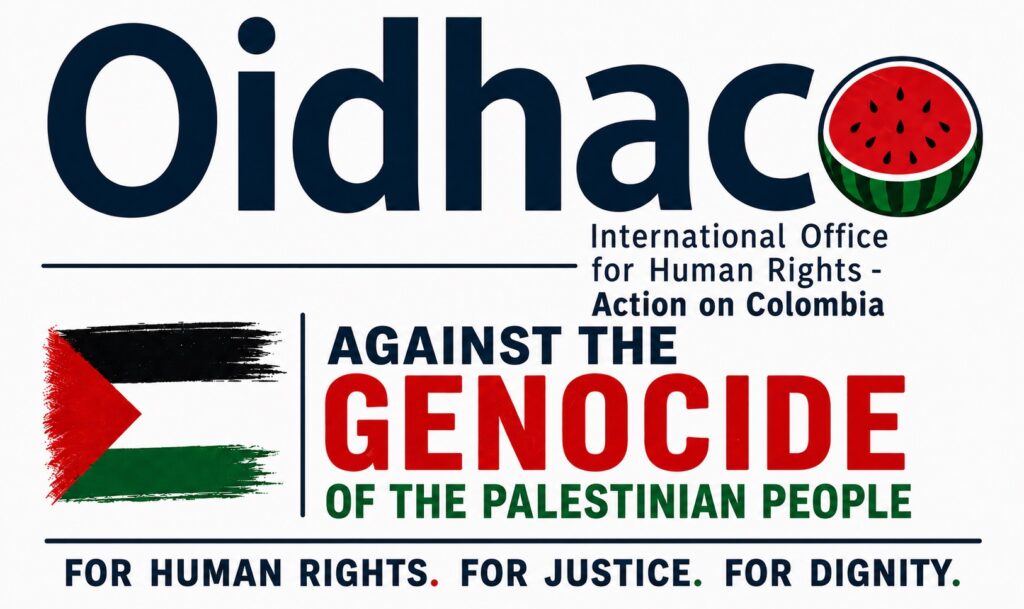
Our solidarity is universal.

We are deeply concerned about all victims of armed conflict, repression and violence around the world — from Sudan to Syria, including the persecution of the Rohingya and so many other crises that often receive less international attention than they deserve. Each of these situations calls for solidarity, remembrance, justice and action.

However, we have decided to specifically highlight the message ‘Stop Genocide in Palestine’ because what is happening in Palestine represents not only a human tragedy of enormous magnitude, but also a direct challenge to the fundamental principles of international humanitarian law and to the rules-based international system itself. The indifference and complicity of much of the international community in the face of the apartheid regime imposed by the Israeli government on the Palestinian people represent one of the greatest moral and political contradictions of our time.

The persistent violation of essential norms — such as the protection of the civilian population, the prohibition of collective punishment and respect for proportionality in the use of force — not only has devastating consequences for the Palestinian population, but also erodes the global mechanisms designed to limit the power of states and prevent abuses.

When these rules are repeatedly breached without any effective consequences, the framework that protects all populations in conflict situations, anywhere in the world, is weakened. Therefore, speaking out in this case does not mean ignoring other forms of suffering, but rather emphasising the urgency of defending an international order which, if it collapses, leaves everyone in a more vulnerable position.

Drawing attention to this situation is, therefore, an act consistent with the universal values we uphold: the protection of life, human dignity and respect for international law, without exception.

Oidhaco logo - Oficina Internacional de derechos Humanos - Acción Colombia
Privacy Overview

This website uses cookies so that we can provide you with the best user experience possible. Cookie information is stored in your browser and performs functions such as recognising you when you return to our website and helping our team to understand which sections of the website you find most interesting and useful.