The International Office for Human Rights Action on Colombia

The fundamental elements of the Victims and Land Restitution Law must be maintained

Public statement of Oidhaco and the Belgian Coordination for Colombia (CBC) on the bill seeking a reform of the Victims and Land Restitution Law.

In light of the proposed Bill 131 of 2018, which aims to reform Law 1448 of 2011 on Victims and Land Restitution, Oidhaco – the International Office for Human Rights – Action on Colombia, and the Belgian Coordination for Colombia (CBC) express their concern about the possible adoption by the Colombian Congress of regressive measures related to land restitution rights for victims of land-grabbing and forced displacement.

Newsletter 16

Colombia must comply with human rights recommendations “The defence of human rights is a firm and unequivocal commitment”(1) . With these words the new President of Colombia announced his political good will to comply with human rights. Nevertheless, w

The defence of human rights is a firm and unequivocal commitment”(1) . With these words the new President of Colombia announced his political good will to comply with human rights. Nevertheless, we believe that his words are not enough. Despite frequent reports in the Colombian and international press, that the human rights situation in Colombia is improving, we believe that this is not the case. We recognise that the situation is not static, and that there are glimpses of change on the horizon. However, we cannot yet talk about improvements. The situation continues to be serious and of great concern, and should be viewed as such by both the Colombian Government and the European Union.

Newsletter 1

From February 4 to March 6 The march on 4 February in protest at FARC-EP and kidnappings was an important political event, in which a significant proportion of the Colombian population took part.

The march on 4 February in protest at FARC-EP and kidnappings was an important political event, in which a significant proportion of the Colombian population took part. It was a peaceful demonstration targeted fundamentally at one of the parties to Colombia’s internal armed conflict. FARC-EP has been responsible for serious violations of International Humanitarian Law which has, without doubt, caused many Colombians to show their condemnation of this guerrilla group.

Newsletter 6

Colombia and the EU’s Scheme of Generalized tariff Preferences (SGP+) Opening a European Commission investigation on Colombia may be the adequate pressure mechanism for Colombian authorities to take United Nations and ILO recommendations seriously.

In 2005, the European Union revised its system of customs preferences for the market access of products coming from developing countries.  The new mechanism, known as “SGP+” includes two country categories: the less developed countries, for which the SGP+

Newsletter 9

Human rights in Colombia under the microscope of the United Nations and European Union Both the follow-up to the conclusions of the Universal Periodic Review of Colombia and the dialogue on human rights between the European Union (EU) and Colombia…

Both the follow-up to the conclusions of the Universal Periodic Review of Colombia and the dialogue on human rights between the European Union (EU) and Colombia offer opportunities to influence policy changes in Bogotá in favour of greater respect for human rights.  We hope that the international community and particularly the EU and its member states will not let this opportunity pass by.

Newsletter 7

Colombia goes before the United Nations Human Rights Council The human rights situation in Colombia was examined on 10 December by the United Nations Human Rights Council through the mechanism of the Universal Periodic Review (UPR).

The human rights situation in Colombia was examined on 10 December by the United Nations Human Rights Council through the mechanism of the Universal Periodic Review (UPR).  Both national and international human rights organisations (in their widest sense) presented reports and now pin their hopes on the outcome of the debate.  However, they are aware of the historic failure of the Colombian government and guerrilla groups to comply with international recommendations, the latter in relation to their responsibility regarding international humanitarian law.

Newsletter 10

European Union – Colombia free trade treaty: the EU’s prestige at stake The third round of trade negotiations between the EU and the three Andean countries (Colombia, Ecuador, and Peru) was held in Brussels from 4 to 8 May.

The third round of trade negotiations between the EU and the three Andean countries (Colombia, Ecuador, and Peru) was held in Brussels from 4 to 8 May.  These negotiations have, since January 2009, replaced negotiations for an association agreement between the EU and the Andean Community.

Newsletter 11

When the state intimidates, persecutes and issues threats DAS’s illegal espionage strategy In February 2009, the Colombian press uncovered the scandal of illegal phone-tapping by DAS…

In February 2009, the Colombian press uncovered the scandal of illegal phone-tapping by DAS (Departamento Administrativo de Seguridad – Administrative Security Department); the targets are human rights defenders, journalists, opposition politicians, and Supreme Court judges. Since then, more information has come to light and more allegations made, thanks in part to the Fiscalía (Attorney General’s Office) which seized documents from DAS during a formal search.

Newsletter 15

DAS: Operation Europe Although Colombia’s intelligence services have played an active role in the repression of civil society movements and human rights organisations for several decades now, the creation of the G-3 special group by the DAS

Although Colombia’s intelligence services have played an active role in the repression of civil society movements and human rights organisations for several decades now, the creation of the G-3 special group by the DAS (Administrative Department of Security) in 2004 marked a new departure.  From this date onwards, a systematic policy of phone-tapping, harassment and intimidation began, with its main victims being human rights defenders, Supreme and Constitutional Court judges, journalists and members of the opposition.  Because they were critical of government policies, all of them were treated like dangerous criminals and as a threat to state interests, and thus the subject of relentless persecution.

Newsletter 14

The flaws within the security policy Ever since he began his time in office in 2002, President Uribe’s policy has been to improve the country’s security and to end the armed conflict militarily.

Ever since he began his time in office in 2002, President Uribe’s policy has been to improve the country’s security and to end the armed conflict militarily. During his two terms, he has promoted controversial measures, several of which were found to be unlawful by the Constitutional Court and many of them criticised by the United Nations. They include initiatives such as the network of civilian informants, which involves the civilian population in the armed conflict, in total disregard of the fact that they are protected persons in line with the principle of distinction between combatants and non-combatants, and exposing these people to possible reprisals. This policy of informants as well as the policy of paying civilians rewards for information and soldiers for the detention or killing of members of illegal groups has been responsible for many acts of injustice, including mass arbitrary detentions and, even more seriously, systematic extrajudicial executions.
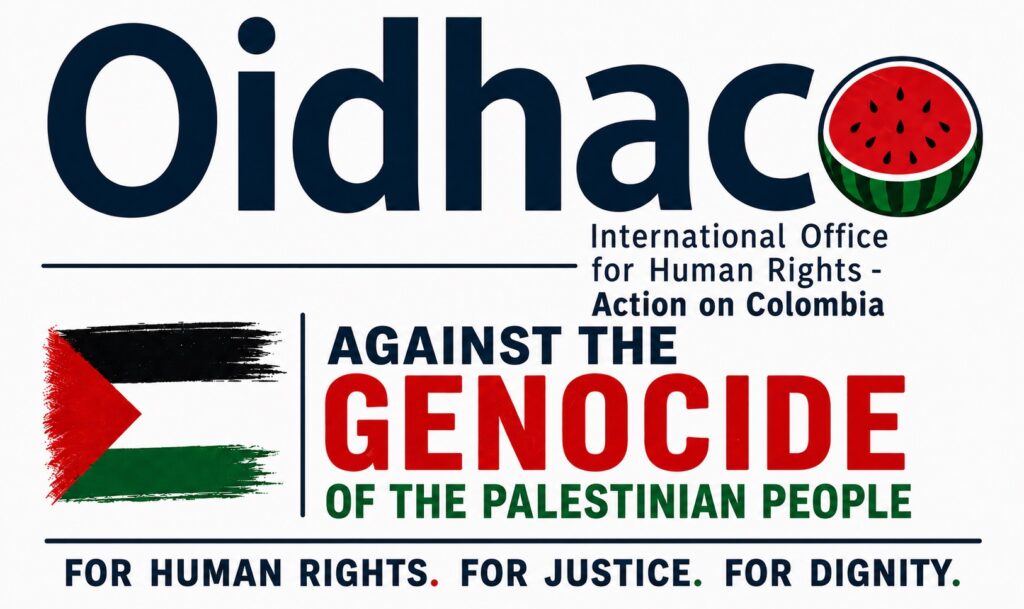
Our solidarity is universal.

We are deeply concerned about all victims of armed conflict, repression and violence around the world — from Sudan to Syria, including the persecution of the Rohingya and so many other crises that often receive less international attention than they deserve. Each of these situations calls for solidarity, remembrance, justice and action.

However, we have decided to specifically highlight the message ‘Stop Genocide in Palestine’ because what is happening in Palestine represents not only a human tragedy of enormous magnitude, but also a direct challenge to the fundamental principles of international humanitarian law and to the rules-based international system itself. The indifference and complicity of much of the international community in the face of the apartheid regime imposed by the Israeli government on the Palestinian people represent one of the greatest moral and political contradictions of our time.

The persistent violation of essential norms — such as the protection of the civilian population, the prohibition of collective punishment and respect for proportionality in the use of force — not only has devastating consequences for the Palestinian population, but also erodes the global mechanisms designed to limit the power of states and prevent abuses.

When these rules are repeatedly breached without any effective consequences, the framework that protects all populations in conflict situations, anywhere in the world, is weakened. Therefore, speaking out in this case does not mean ignoring other forms of suffering, but rather emphasising the urgency of defending an international order which, if it collapses, leaves everyone in a more vulnerable position.

Drawing attention to this situation is, therefore, an act consistent with the universal values we uphold: the protection of life, human dignity and respect for international law, without exception.

Oidhaco logo - Oficina Internacional de derechos Humanos - Acción Colombia
Privacy Overview

This website uses cookies so that we can provide you with the best user experience possible. Cookie information is stored in your browser and performs functions such as recognising you when you return to our website and helping our team to understand which sections of the website you find most interesting and useful.