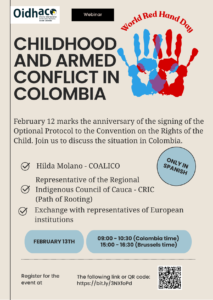
Childhood and Armed Conflict in Colombia
February 13th – 09:00 – 10:30 (Colombia time) – 15:00 – 16:30 (Brussels time)

February 13th – 09:00 – 10:30 (Colombia time) – 15:00 – 16:30 (Brussels time)

The 16th Human Rights Dialogue between the European Union (EU) and Colombia took place on 1 December 2025 in Brussels. The dialogue was chaired, on behalf of the EU, by the European Union Special Representative for Human Rights, Kajsa Ollongren, and, on behalf of Colombia, by the Deputy Minister for Multilateral Affairs of the Republic

Social and human rights organisations in Latin America and Europe express deep concern about unilateral military actions that violate the sovereignty of States and the fundamental principles of international law. The use of force outside the framework of international law and outside the United Nations Charter seriously jeopardises the lives of civilians, regional stability and

Oidhaco once again expresses[1] its concern regarding the situation faced by ethnic and peasant communities of the Lower Atrato, department of Chocó. In this department, the humanitarian crisis continues to deepen. According to OCHA[2], between January and September 2025, Chocó has been one of the regions most affected by the armed conflict, registering severe mobility

The CCEEU (Colombia-Europe-United States Coordination), the Colombian Platform for Human Rights, Democracy and Development, and the Alliance of Social and Related Organisations for International Cooperation for Peace and Democracy in Colombia are presenting the current challenges in human rights, peace and corporate responsibility in Brussels and presenting the report ‘The Challenge of Change’ on the

Today, 20 November, is World Children’s Day. World Children’s Day commemorates the adoption of the Convention on the Rights of the Child (1989) on 20 November. As the UN emphasises, ‘from the moment the sun rises, children wake up to a world shaped by choices they didn’t make. But every child, everywhere, also wakes with

Event on three years of the government of change in Colombia

Below the statement made by OIDHACO during the 60th session of the Human Rights Council in the interactive dialogue with the Working Group of Experts on People of African Descent.

A key space to discuss how to strengthen EU–LAC cooperation with a focus on human rights and sustainability.

We are delighted to share this news about the National Human Rights Award in Colombia, which is presented by our member Diakonia Sweden and Act Swedish Church with the support of the Swedish Embassy in Colombia. Category: “Defender of the Year” A person whose work over the past year has been a significant testimony to
We are deeply concerned about all victims of armed conflict, repression and violence around the world — from Sudan to Syria, including the persecution of the Rohingya and so many other crises that often receive less international attention than they deserve. Each of these situations calls for solidarity, remembrance, justice and action.
However, we have decided to specifically highlight the message ‘Stop Genocide in Palestine’ because what is happening in Palestine represents not only a human tragedy of enormous magnitude, but also a direct challenge to the fundamental principles of international humanitarian law and to the rules-based international system itself. The indifference and complicity of much of the international community in the face of the apartheid regime imposed by the Israeli government on the Palestinian people represent one of the greatest moral and political contradictions of our time.
The persistent violation of essential norms — such as the protection of the civilian population, the prohibition of collective punishment and respect for proportionality in the use of force — not only has devastating consequences for the Palestinian population, but also erodes the global mechanisms designed to limit the power of states and prevent abuses.
When these rules are repeatedly breached without any effective consequences, the framework that protects all populations in conflict situations, anywhere in the world, is weakened. Therefore, speaking out in this case does not mean ignoring other forms of suffering, but rather emphasising the urgency of defending an international order which, if it collapses, leaves everyone in a more vulnerable position.
Drawing attention to this situation is, therefore, an act consistent with the universal values we uphold: the protection of life, human dignity and respect for international law, without exception.