Gender
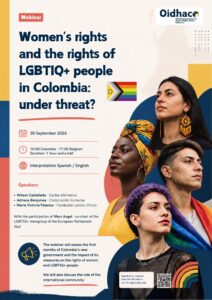
Women’s rights and the rights of LGBTIQ+ people in Colombia: under threat?
Webinar 30 September 2026
Webinar 30 September 2026
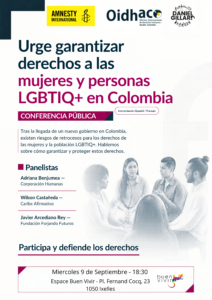
Following the arrival of a new government in Colombia, there is a risk of setbacks for the rights of women and LGBTIQ+ people. Let’s discuss how to guarantee and protect these rights. The event will feature interpretation between Spanish and French only.

OIDHACO is participating as a partner organisation in the International Meeting of Women Searchers and invites individuals, organisations and institutions committed to the defence of human rights and the fight against enforced disappearances to learn about the initiative and take part in this international forum. Enforced disappearances affect thousands of people worldwide. In the absence
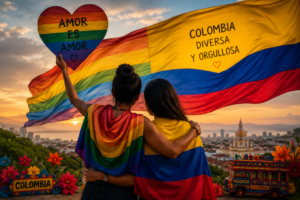
As part of Pride Month, the Inter-American Commission on Human Rights (IACHR) reiterated that Pride marches and other public expressions by LGBTIQ+ people constitute legitimate manifestations of freedom of expression, democratic participation and the defence of human rights, which must be protected by States. This call takes on particular significance in Colombia, where the 2026
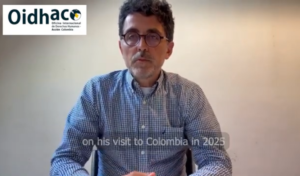
As part of the 62nd session of the United Nations Human Rights Council in Geneva, OIDHACO spoke during the dialogue with the Independent Expert on protection against violence and discrimination on the grounds of sexual orientation and gender identity. Link to the full session OIDHACO also took the floor during the interactive dialogue with the
The RRW is a funding mechanism of the United Nations Women’s Peace and Humanitarian Fund (WPHF)that supports urgent, short-term, strategic initiatives led by women peacebuilders and women’s civilsociety organizations, to increase women’s participation and influence in formal peace processes and theimplementation of international, national or sub-national peace agreements.
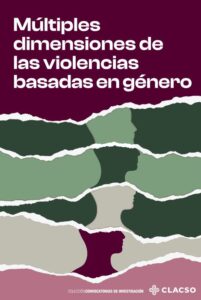
CLACSO Research We recommend reading this study (in spanish), produced by researchers from Argentina, Bolivia, Colombia, Paraguay and Guatemala. This work brings five studies into dialogue with one another, forming a coherent picture: gender-based violence is neither isolated incidents nor a temporary phenomenon, but rather structural mechanisms activated and reconfigured within a global context where
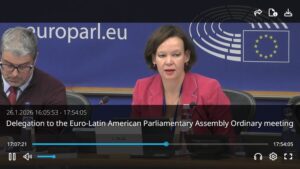
The debate drew on: The CELAC-EU Civil Society Working Group, a coalition of more than 80 civil society organisations, networks and platforms from Latin America and the Caribbean and the European Union, of which OIDHACO is a member, aims to monitor the commitments made at official summits and in the CELAC-EU Roadmap to ensure they