The International Office for Human Rights Action on Colombia

V Follow-up Report on the Recommendations of the Truth Commission

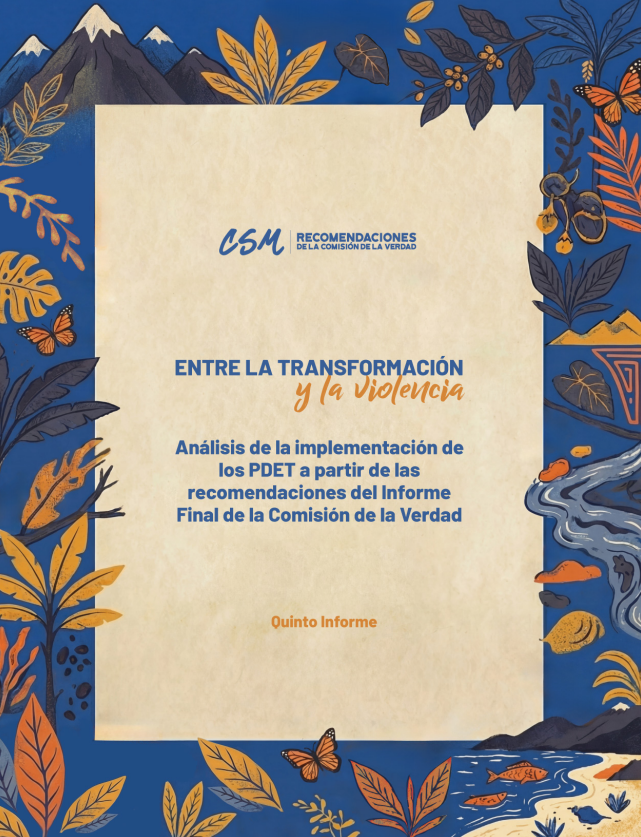
In January, the Monitoring and Follow-up Commission (CMS) for the recommendations of the Truth Clarification Commission (CEV) presented its fifth follow-up report (in spanish only), analysing the implementation of the Territorially Focused Development Programmes (PDET) based on the CEV’s recommendations.

In its conclusions, CMS highlights significant progress, but notes that “this progress is mainly concentrated in the areas of infrastructure and services, while those areas aimed at social transformation — reconciliation, land management, education and rural health — show the lowest levels of implementation.”

They make 18 calls to action (Programmatic alignment; Multilevel coordination; Centrality of rurality; Rural women; Territorial narrative; Participatory evaluation; Cross-cutting approaches; Ethnic peoples; LGBTIQ+ persons; Rural youth; Collective reparation; Security and protection; Data and information; Congress of the Republic; Inclusion of recommendations in the PATRs; Electoral guarantees in PDET territories; International support for the PDETs; Compliance with the international human rights system).

The CMS toured Europe in October last year and visited Brussels to meet with European institutions. We therefore wish to highlight call to action 17 addressed to the international community:

To the international community, cooperation agencies, and multilateral organisations: continue to provide political and financial support for the implementation of the Final Peace Agreement, with special emphasis on the PDET territories. This support includes:
1) technical and financial assistance for territorial transformation initiatives;
2) independent monitoring of progress in human rights;
3) support for civil society organisations working for peace in the territories;
4) coordination of humanitarian action with stabilisation strategies in the subregions most affected by violence.”

You can also watch the presentation ceremony at this link, where you can hear testimonials from the territories.

Our solidarity is universal.

We are deeply concerned about all victims of armed conflict, repression and violence around the world — from Sudan to Syria, including the persecution of the Rohingya and so many other crises that often receive less international attention than they deserve. Each of these situations calls for solidarity, remembrance, justice and action.

However, we have decided to specifically highlight the message ‘Stop Genocide in Palestine’ because what is happening in Palestine represents not only a human tragedy of enormous magnitude, but also a direct challenge to the fundamental principles of international humanitarian law and to the rules-based international system itself. The indifference and complicity of much of the international community in the face of the apartheid regime imposed by the Israeli government on the Palestinian people represent one of the greatest moral and political contradictions of our time.

The persistent violation of essential norms — such as the protection of the civilian population, the prohibition of collective punishment and respect for proportionality in the use of force — not only has devastating consequences for the Palestinian population, but also erodes the global mechanisms designed to limit the power of states and prevent abuses.

When these rules are repeatedly breached without any effective consequences, the framework that protects all populations in conflict situations, anywhere in the world, is weakened. Therefore, speaking out in this case does not mean ignoring other forms of suffering, but rather emphasising the urgency of defending an international order which, if it collapses, leaves everyone in a more vulnerable position.

Drawing attention to this situation is, therefore, an act consistent with the universal values we uphold: the protection of life, human dignity and respect for international law, without exception.

Oidhaco logo - Oficina Internacional de derechos Humanos - Acción Colombia
Privacy Overview

This website uses cookies so that we can provide you with the best user experience possible. Cookie information is stored in your browser and performs functions such as recognising you when you return to our website and helping our team to understand which sections of the website you find most interesting and useful.