The International Office for Human Rights Action on Colombia

OIDHACO co-organizes side event at the 60th session of the UN Human Rights Council

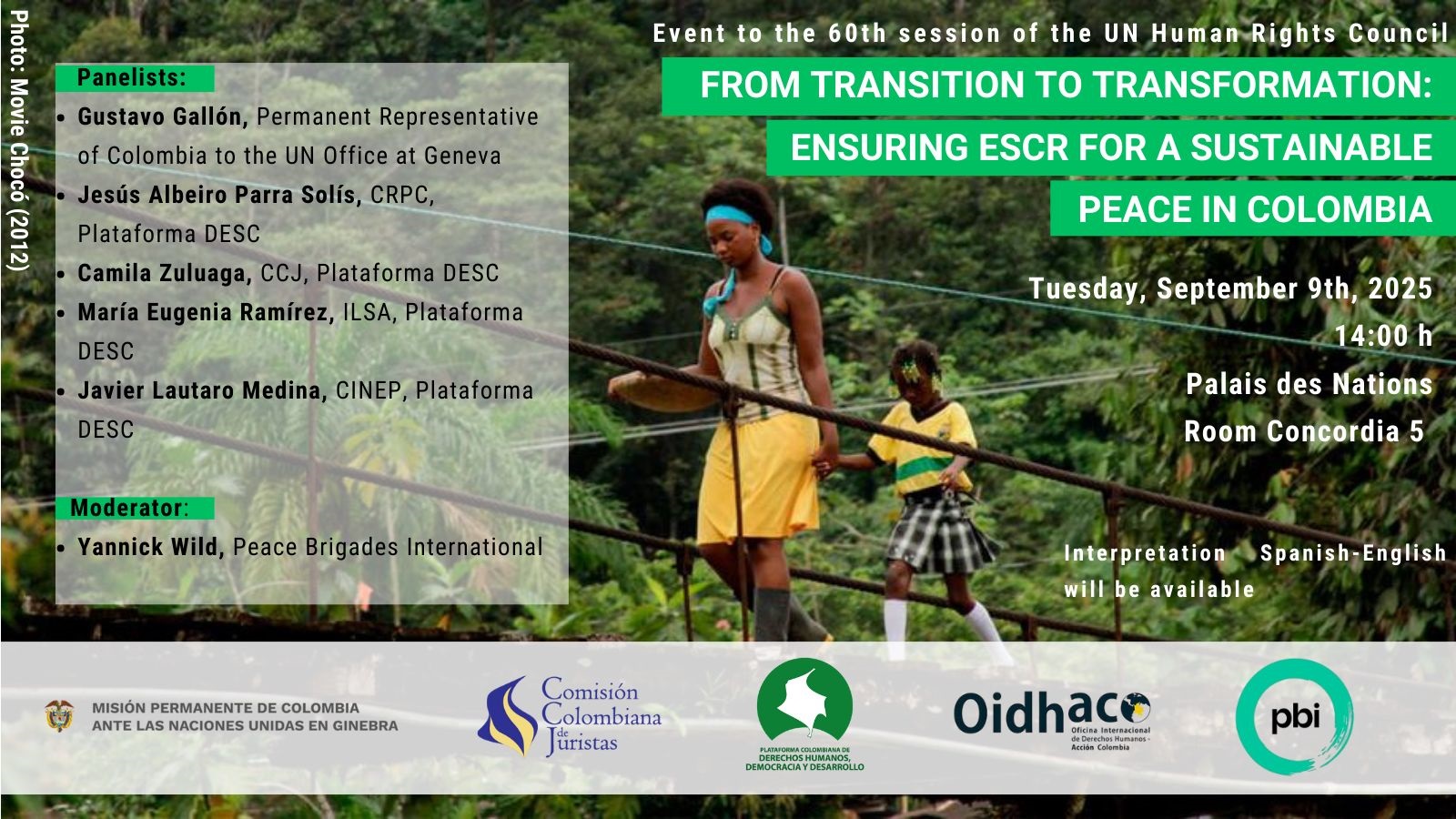
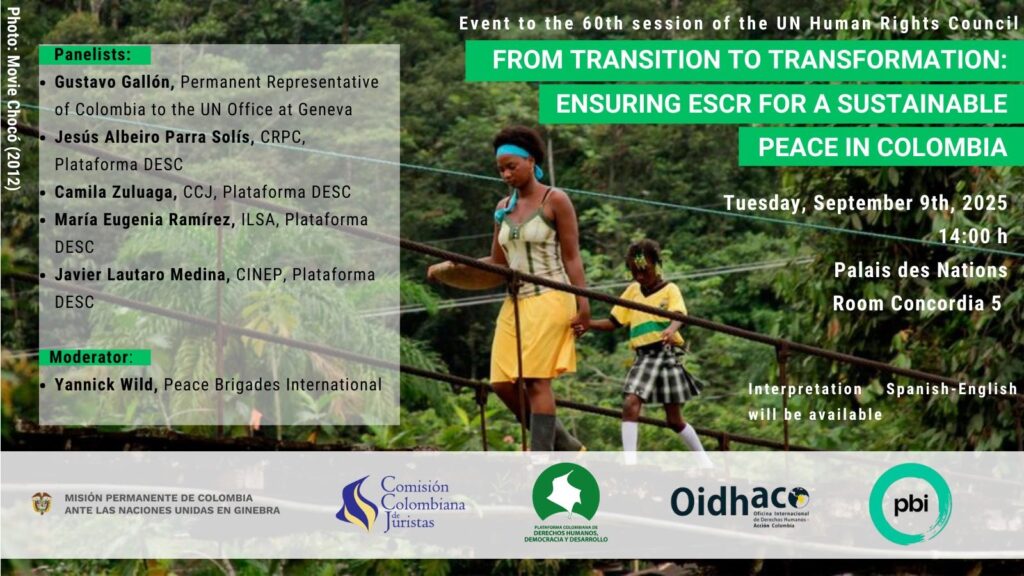
On September 9, within the framework of the 60th session of the United Nations Human Rights Council in Geneva, the side event “From Transition to Transformation: Ensuring ESCR for a Sustainable Peace in Colombia” will take place in Room Concordia 5 at the Palais des Nations (2:00 – 3:00 p.m.).

This dialogue space seeks to reflect on the challenges and opportunities Colombia faces in guaranteeing economic, social, cultural and environmental rights (ESCR) as an indispensable condition for the non-repetition of violence and the construction of a sustainable peace.

The event builds on the recommendations of the UN Committee on Economic, Social and Cultural Rights (CESCR), which in its review of Colombia stressed the importance of the comprehensive implementation of the 2016 Peace Agreement, particularly regarding the effective participation of women, the Comprehensive Rural Reform, and the substitution of illicit crops. Nine years after the signing of the Agreement, progress remains limited, and rural and ethnic communities continue to face serious risks due to ongoing violence from multiple armed actors.

The event will feature panelists from Colombian civil society, academia, and the State, and will be held in a conversational format with English–Spanish interpretation.

OIDHACO, together with the Permanent Mission of Colombia to the United Nations in Geneva, the Colombian Commission of Jurists, the Colombian Platform for Human Rights, Democracy and Development, and Peace Brigades International, is part of the coordinating team for the organization of this space. With this, we reaffirm our commitment to raising international awareness of Colombia’s human rights and peacebuilding challenges, fostering dialogue between civil society, the State, and the international community.

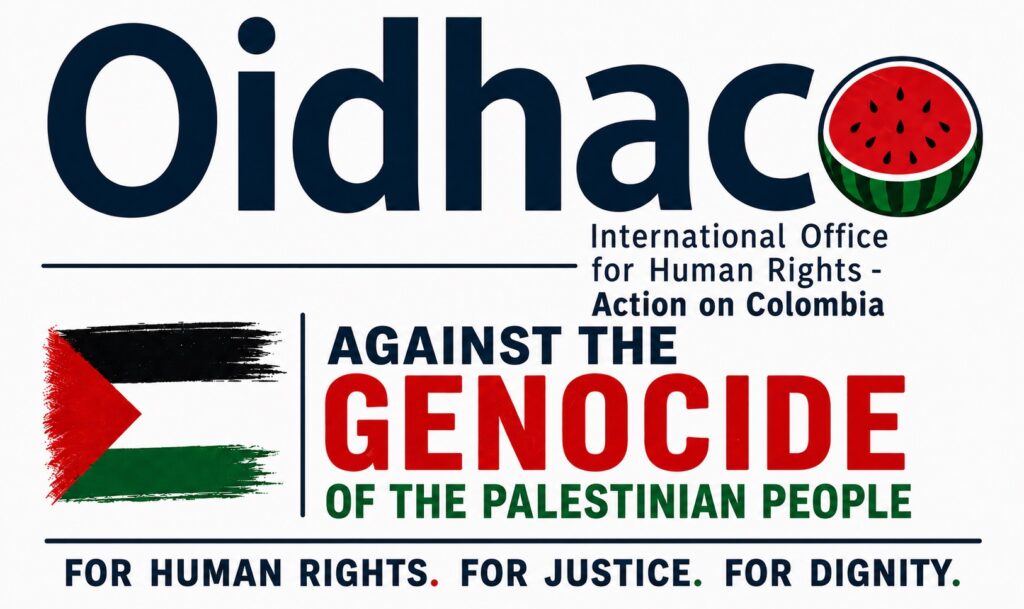
Our solidarity is universal.

We are deeply concerned about all victims of armed conflict, repression and violence around the world — from Sudan to Syria, including the persecution of the Rohingya and so many other crises that often receive less international attention than they deserve. Each of these situations calls for solidarity, remembrance, justice and action.

However, we have decided to specifically highlight the message ‘Stop Genocide in Palestine’ because what is happening in Palestine represents not only a human tragedy of enormous magnitude, but also a direct challenge to the fundamental principles of international humanitarian law and to the rules-based international system itself. The indifference and complicity of much of the international community in the face of the apartheid regime imposed by the Israeli government on the Palestinian people represent one of the greatest moral and political contradictions of our time.

The persistent violation of essential norms — such as the protection of the civilian population, the prohibition of collective punishment and respect for proportionality in the use of force — not only has devastating consequences for the Palestinian population, but also erodes the global mechanisms designed to limit the power of states and prevent abuses.

When these rules are repeatedly breached without any effective consequences, the framework that protects all populations in conflict situations, anywhere in the world, is weakened. Therefore, speaking out in this case does not mean ignoring other forms of suffering, but rather emphasising the urgency of defending an international order which, if it collapses, leaves everyone in a more vulnerable position.

Drawing attention to this situation is, therefore, an act consistent with the universal values we uphold: the protection of life, human dignity and respect for international law, without exception.

Oidhaco logo - Oficina Internacional de derechos Humanos - Acción Colombia
Privacy Overview

This website uses cookies so that we can provide you with the best user experience possible. Cookie information is stored in your browser and performs functions such as recognising you when you return to our website and helping our team to understand which sections of the website you find most interesting and useful.