The International Office for Human Rights Action on Colombia

Who is the new European development cooperation policy benefiting?

Lack of transparency and doubts on the real impacts and benefits of cooperation aid through the private sector are some of the issues that have been discussed today during a conference at the European Parliament.

Brussels, 21st March 2013. The civil society networks: ALOP, APRODEV, CIDSE, CIFCA, COUNTER BALANCE, EURODAD, GRUPO SUR and OIDHACO, together with European Parliamentarians from five political groups, organised the conference: “Aid to the private sector: promoting responsible investments? Latin America as a testing ground”, which took place on Thursday 21st March at the European Parliament.

The European Parliament urges the Colombian government and the FARC to guarantee lasting peace

Letter to the protagonists of the peace talks in Havana insists on the importance of civil society participation and call for the reform to military jurisdiction to be withdrawn.

Brussels, 18 December 2012. 20 Members of the European Parliament have sent a letter today to the Colombian government and the FARC in which they “warmly greet the efforts of the Colombian government and the FARC to begin dialogues to seek an end to the armed conflict” which they describe as a “historic moment” for Colombia. They urge both parties to cease fire – noting the recent declaration made by FARC – and remind them of their duty to respect human rights and international humanitarian law.

Newsletter 4

European Policy on Colombia The 23 May 2008, in Paris and simultaneously to its general assembly, OIDHACO presented to the press its recommendations on Colombia for the Slovenian and French Presidencies of the European Union (EU).

The 23 May 2008, in Paris and simultaneously to its general assembly, OIDHACO presented to the press its recommendations on Colombia for the Slovenian and French Presidencies of the European Union (EU). The document, which is supported by 60 European organisations, had been previously submitted to the Slovenian and French governments (respectively the 7 and 22 May 2008).

Civil society networks welcome European Parliament position on the future EU development cooperation with Latin America

Civil society networks ALOP, APRODEV, CIDSE, CIFCA, GRUPO SUR and OIDHACO welcome the European Parliament (EP) resolution of 12 June 2012 on defining new development cooperation with Latin America.

In a region where 180 million people – one in three persons -live below the poverty line, it is paramount that the EU take due consideration of the widespread poverty and inequality when defining its development cooperation. In particular we support the following recommendations of the EP and urge that they be effectively included within the Development Cooperation Instrument (DCI):

Recommendations letter to the EU on Colombia

In 2010, Oidhaco sent a series of recommendations to the Spanish and Belgian Presidencies of the European Union, supported by some 90 European and international human rights organisations, development agencies, solidarity groups and church organisations. On 18th and 19th May 2011, the International Office on Human Rights Action on Colombia (Oidhaco) held its General Assembly, composed of 32 European and international organisations, and Colombian human rights coordination groups. We believe that the recommendations we made in 2010 (please find attached) are unfortunately still all too relevant this year, and so we attach them once again for your consideration

In August 2010 the new government in Colombia expressed a public commitment to the promotion and defence of human rights as a “profound democratic, ethical and human conviction”; promised to address the structural causes of poverty; and showed openness to the possibility of dialogue as a path to peace within Colombia. Civil society organisations in Europe and Colombia alike have been asking for these statements to be quickly translated into substantial, concrete and effective policies that will make a real difference in the lives of victims of human rights violations and their defenders. However, to date, some 8 months into the administration, we find that massive human rights violations persist, that Colombia still remains an extremely dangerous place in which to defend human rights, and that there has been no real improvement in the lives of poor and marginalised communities.
Human rights situation in Colombia – DROI hearing – 19 March 2012

Analysis on the situation in Colombia on the occasion of the hearing of the Human Rights Sub-Committee of the European Parliament. It deals with, among others, the persistent violations of IHL, impunity and attacks against human rights defenders.

In the face of the lack of guarantees for the fulfilment of human rights in Colombia, continued impunity, the persistence of the armed conflict, as well as the lack of mechanisms in the Agreement to guarantee real protection for human rights, OIDHACO considers that the European Parliament should not ratify the Agreement with Colombia while there are not significant changes with regards to these issues. The ratification of the Agreement with Colombia would give out a signal of approval for the policies of the Colombian government, and ignore the serious violations of human rights and international humanitarian law committed in the country.

Report: Women Human Rights defenders and the struggle for Justice in Colombia

This joint report by ABColombia, U.S. Office on Colombia (USOC) and Oidhaco presents the situation of women who fight for the respect of human rights and rule of law in Colombia.

Colombia continues to suffer one of the worst humanitarian and human rights crises in the world. Since the change of administration in August 2010, the new government of President Juan Manuel Santos has issued public statements in support of human rights defenders, initiated more open engagement and dialogue and shown a commitment to end the public stigmatization of defenders. However, despite the change in tone, the situation on the ground continues to cause concern.

Newsletter 16

Colombia must comply with human rights recommendations “The defence of human rights is a firm and unequivocal commitment”(1) . With these words the new President of Colombia announced his political good will to comply with human rights. Nevertheless, w

The defence of human rights is a firm and unequivocal commitment”(1) . With these words the new President of Colombia announced his political good will to comply with human rights. Nevertheless, we believe that his words are not enough. Despite frequent reports in the Colombian and international press, that the human rights situation in Colombia is improving, we believe that this is not the case. We recognise that the situation is not static, and that there are glimpses of change on the horizon. However, we cannot yet talk about improvements. The situation continues to be serious and of great concern, and should be viewed as such by both the Colombian Government and the European Union.

Newsletter 6

Colombia and the EU’s Scheme of Generalized tariff Preferences (SGP+) Opening a European Commission investigation on Colombia may be the adequate pressure mechanism for Colombian authorities to take United Nations and ILO recommendations seriously.

In 2005, the European Union revised its system of customs preferences for the market access of products coming from developing countries.  The new mechanism, known as “SGP+” includes two country categories: the less developed countries, for which the SGP+

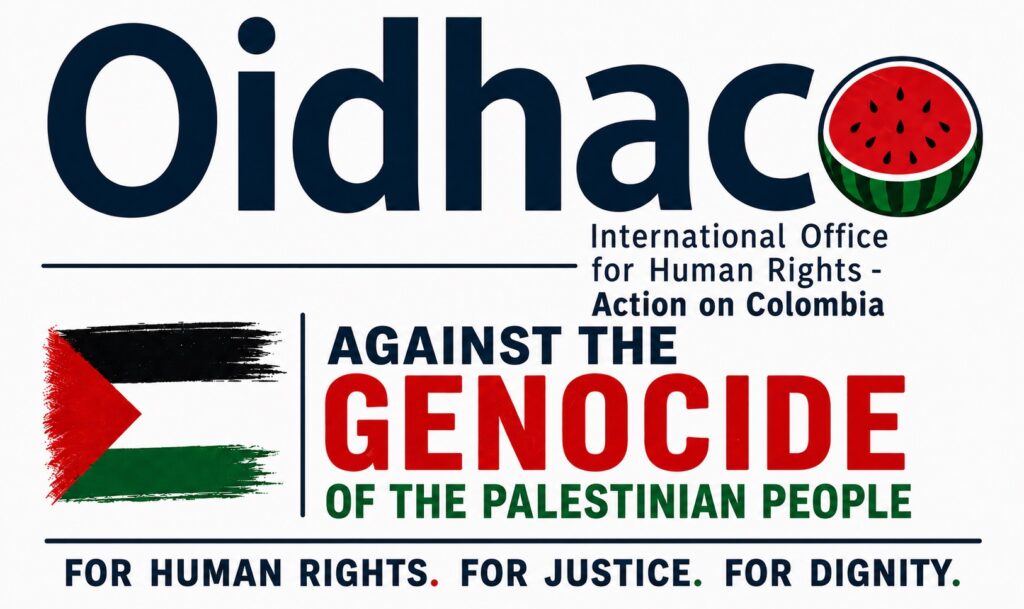
Our solidarity is universal.

We are deeply concerned about all victims of armed conflict, repression and violence around the world — from Sudan to Syria, including the persecution of the Rohingya and so many other crises that often receive less international attention than they deserve. Each of these situations calls for solidarity, remembrance, justice and action.

However, we have decided to specifically highlight the message ‘Stop Genocide in Palestine’ because what is happening in Palestine represents not only a human tragedy of enormous magnitude, but also a direct challenge to the fundamental principles of international humanitarian law and to the rules-based international system itself. The indifference and complicity of much of the international community in the face of the apartheid regime imposed by the Israeli government on the Palestinian people represent one of the greatest moral and political contradictions of our time.

The persistent violation of essential norms — such as the protection of the civilian population, the prohibition of collective punishment and respect for proportionality in the use of force — not only has devastating consequences for the Palestinian population, but also erodes the global mechanisms designed to limit the power of states and prevent abuses.

When these rules are repeatedly breached without any effective consequences, the framework that protects all populations in conflict situations, anywhere in the world, is weakened. Therefore, speaking out in this case does not mean ignoring other forms of suffering, but rather emphasising the urgency of defending an international order which, if it collapses, leaves everyone in a more vulnerable position.

Drawing attention to this situation is, therefore, an act consistent with the universal values we uphold: the protection of life, human dignity and respect for international law, without exception.

Oidhaco logo - Oficina Internacional de derechos Humanos - Acción Colombia
Privacy Overview

This website uses cookies so that we can provide you with the best user experience possible. Cookie information is stored in your browser and performs functions such as recognising you when you return to our website and helping our team to understand which sections of the website you find most interesting and useful.