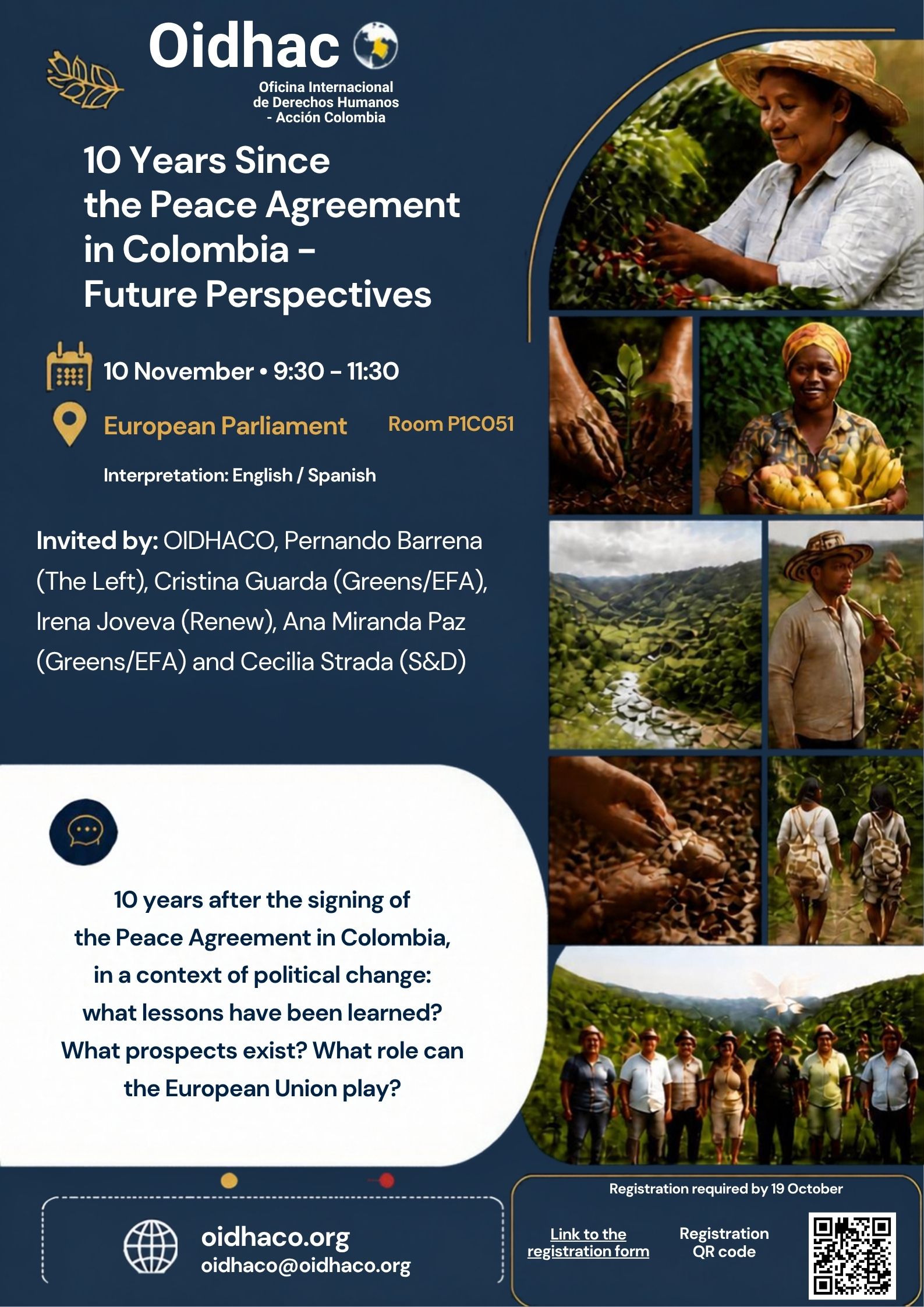
Event at the European Parliament to mark the tenth anniversary of the signing of the peace agreement in Colombia.

REGISTRATION IS OPEN until 19 October

It has been 10 years since the signing of the Peace Agreement in Colombia between the Colombian Government and the FARC-EP. Ten years on, where do we stand? What progress has been made? What remains to be done? Against the backdrop of a new Colombian government, what are the current challenges?

With contributions from the co-hosting MEPs.

Featuring:

  • Adrianus Koetsenruijter: European Union Special Envoy for the Peace Process in Colombia, appointed in April 2024 to strengthen international support for the implementation of the 2016 Agreement and the Colombian Government’s regional peace initiatives.
  • Representative of the Permanent Representation of Ireland: Ireland brings two key aspects to this event: its Presidency of the Council of the EU and its recognised expertise in conflict resolution, based on its own peace process, which served as a key reference point for the 2016 Agreement in Colombia.
  • Diego Tovar: Speaker for International Action for Peace (IAP); President of the Centre for Thought and Political Dialogue; a signatory to the Havana Peace Agreement; and a leading figure in Colombia’s peace process. He has been a delegate to the CSIVI – House of Representatives since May 2023, and was appointed as the representative of the High Contracting Party to the Final Peace Agreement to the UN Security Council in 2024. He has held various roles related to reintegration, peace-building and the social empowerment of signatory communities. He has also participated in various national and international forums.
  • Aura Rodríguez Bonilla, economist and human rights defender. She is currently the Director of the Viva la Ciudadanía Foundation and Technical Secretary of the Colombian Platform for Human Rights, Democracy and Development. Her main areas of expertise are civic participation and human rights, as well as economic, social, cultural and environmental rights, and the right to the city. Her analytical approach encompasses issues such as democracy and economic, social and cultural rights.
  • María Cedeño Sarmiento, a human rights defender with over twenty years’ experience. She currently serves as Secretary-General of the Committee for Solidarity with Political Prisoners Foundation and as political spokesperson for the Caribbean Node of the Colombia–Europe–United States Coordination (CCEEU), as well as regional spokesperson for the department of Atlántico on the National Guarantees Committee. Her analysis covers issues such as the protection of human rights defenders and social leaders, as well as peace-building in Colombia.
  • Wilson Castañeda Castro. Director of the Corporación Caribe Afirmativo, political scientist and Doctor of Philosophy. For over 20 years, he has worked to promote the rights of LGBTIQ+ people and to build peace at a local level. He supported the Gender Sub-Commission during the Havana peace talks. He is currently chair of the Committee for Monitoring the Recommendations of the Commission for the Clarification of the Truth, Coexistence and Non-Repetition of the Armed Conflict in Colombia. He is spokesperson for the Alliance of Social and Related Organisations for Cooperation for Peace and Democracy in Colombia.
Share:

On Key

Related Posts

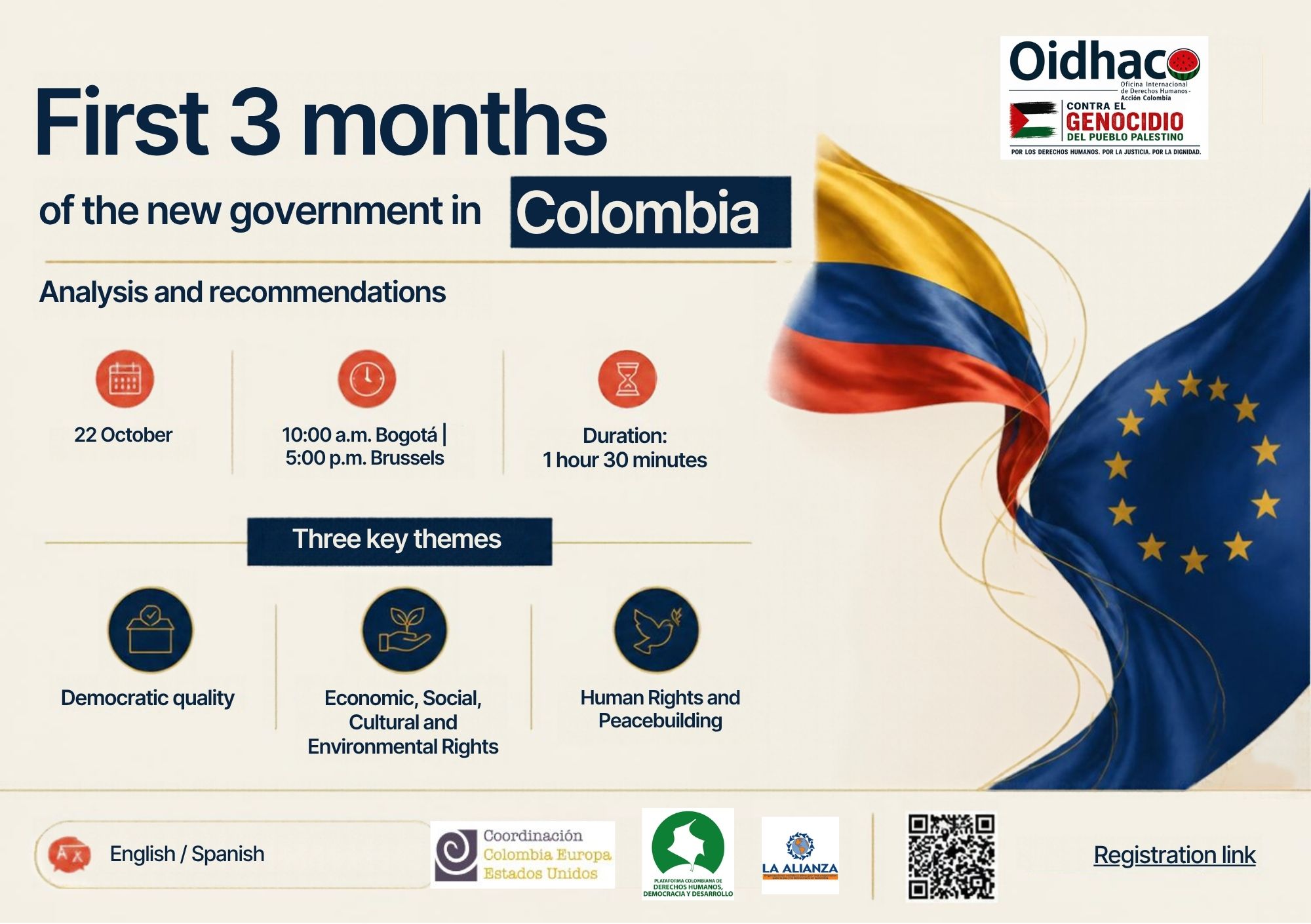
Webinar: Analysis of the first three months of government – Colombia

22 October, 10.00 Colombian time / 17.00 Brussels time. With three months having passed since Abelardo de la Espriella took office, it is important to create a space for reflection and monitoring of his initial decisions and policies, particularly in relation to the quality of democracy, economic, social, cultural and environmental rights, human rights and

UN report warns of the recruitment of Colombians for conflicts abroad

A new United Nations report warns of an increase in the recruitment of Colombians to take part in armed conflicts in other countries. Offers are mainly circulated via social media and through contacts with former members of the armed forces, with promises of high salaries and jobs in security or logistics. In some cases, those

Our solidarity is universal.

We are deeply concerned about all victims of armed conflict, repression and violence around the world — from Sudan to Syria, including the persecution of the Rohingya and so many other crises that often receive less international attention than they deserve. Each of these situations calls for solidarity, remembrance, justice and action.

However, we have decided to specifically highlight the message ‘Stop Genocide in Palestine’ because what is happening in Palestine represents not only a human tragedy of enormous magnitude, but also a direct challenge to the fundamental principles of international humanitarian law and to the rules-based international system itself. The indifference and complicity of much of the international community in the face of the apartheid regime imposed by the Israeli government on the Palestinian people represent one of the greatest moral and political contradictions of our time.

The persistent violation of essential norms — such as the protection of the civilian population, the prohibition of collective punishment and respect for proportionality in the use of force — not only has devastating consequences for the Palestinian population, but also erodes the global mechanisms designed to limit the power of states and prevent abuses.

When these rules are repeatedly breached without any effective consequences, the framework that protects all populations in conflict situations, anywhere in the world, is weakened. Therefore, speaking out in this case does not mean ignoring other forms of suffering, but rather emphasising the urgency of defending an international order which, if it collapses, leaves everyone in a more vulnerable position.

Drawing attention to this situation is, therefore, an act consistent with the universal values we uphold: the protection of life, human dignity and respect for international law, without exception.

Oidhaco logo - Oficina Internacional de derechos Humanos - Acción Colombia
Privacy Overview

This website uses cookies so that we can provide you with the best user experience possible. Cookie information is stored in your browser and performs functions such as recognising you when you return to our website and helping our team to understand which sections of the website you find most interesting and useful.