The International Office for Human Rights Action on Colombia

International statement condemning attacks and threats against Afro-Colombian and indigenous leaders

The European organisations and networks who have signed this statement reject the murder attempt against leaders from Afro-Colombian collectives from the Cauca department ACONC, PCN and ASOM and threats against the indigenous women’s organisation Wayúu Wo

On 5 May, leaders from the Association of Community Councils of Northern Cauca (Asociación de Consejos Comunitarios del Norte del Cauca – ACONC), the Black Communities Process (Proceso de Comunidades Negras – PCN) and the Association of Women of African Descent from Northern Cauca (Asociación de mujeres afrodescendientes del Norte del Cauca – ASOM), were the victims of an attempted murder and massacre when guns and a grenade were fired in the village of Lomitas, in the municipality of Santander de Quilichao, Cauca department.

European Parliamentarians support women’s march for peace in Colombia

They ask the negotiators in Havana to listen to the demands of women and victims and the parties at the dialogue table to declare a bilateral cease -fire.

Brussels, November 21 2012. More than 20 MEPs from the European Alliance of Socialists and Democrats, the Greens European Free Alliance and the European United Left have sent a letter for the march which will take place tomorrow in Colombia in support of the peace process. The main request of the march, organized by the Women for Peace network (Mujeres por la Paz) is that neither the government nor the FARC leave the negotiating table before signing a Peace Agreement.

Newsletter 4

European Policy on Colombia The 23 May 2008, in Paris and simultaneously to its general assembly, OIDHACO presented to the press its recommendations on Colombia for the Slovenian and French Presidencies of the European Union (EU).

The 23 May 2008, in Paris and simultaneously to its general assembly, OIDHACO presented to the press its recommendations on Colombia for the Slovenian and French Presidencies of the European Union (EU). The document, which is supported by 60 European organisations, had been previously submitted to the Slovenian and French governments (respectively the 7 and 22 May 2008).

Report: Women Human Rights defenders and the struggle for Justice in Colombia

This joint report by ABColombia, U.S. Office on Colombia (USOC) and Oidhaco presents the situation of women who fight for the respect of human rights and rule of law in Colombia.

Colombia continues to suffer one of the worst humanitarian and human rights crises in the world. Since the change of administration in August 2010, the new government of President Juan Manuel Santos has issued public statements in support of human rights defenders, initiated more open engagement and dialogue and shown a commitment to end the public stigmatization of defenders. However, despite the change in tone, the situation on the ground continues to cause concern.

Newsletter 7

Colombia goes before the United Nations Human Rights Council The human rights situation in Colombia was examined on 10 December by the United Nations Human Rights Council through the mechanism of the Universal Periodic Review (UPR).

The human rights situation in Colombia was examined on 10 December by the United Nations Human Rights Council through the mechanism of the Universal Periodic Review (UPR).  Both national and international human rights organisations (in their widest sense) presented reports and now pin their hopes on the outcome of the debate.  However, they are aware of the historic failure of the Colombian government and guerrilla groups to comply with international recommendations, the latter in relation to their responsibility regarding international humanitarian law.

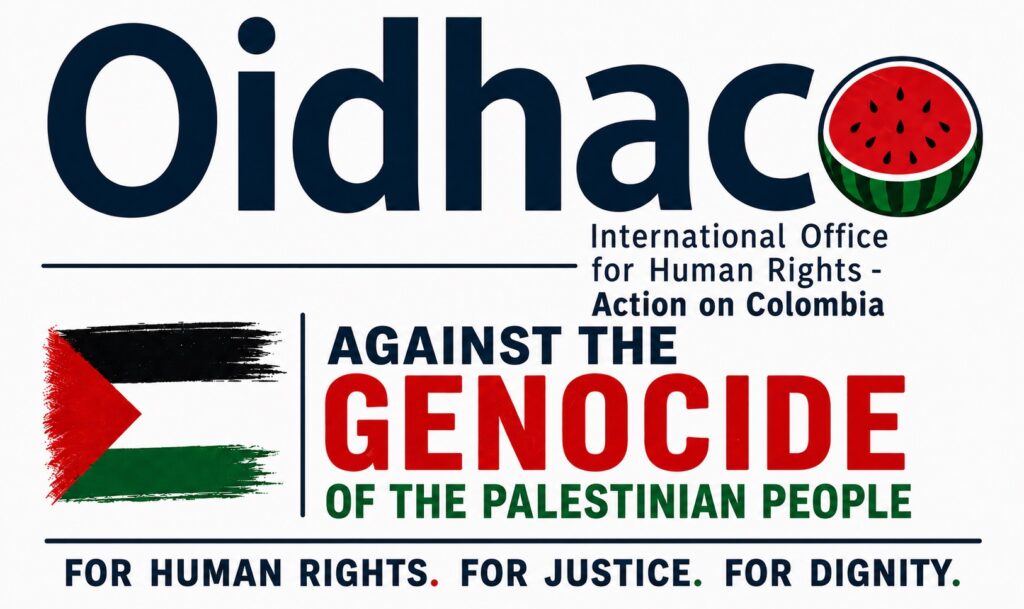
Our solidarity is universal.

We are deeply concerned about all victims of armed conflict, repression and violence around the world — from Sudan to Syria, including the persecution of the Rohingya and so many other crises that often receive less international attention than they deserve. Each of these situations calls for solidarity, remembrance, justice and action.

However, we have decided to specifically highlight the message ‘Stop Genocide in Palestine’ because what is happening in Palestine represents not only a human tragedy of enormous magnitude, but also a direct challenge to the fundamental principles of international humanitarian law and to the rules-based international system itself. The indifference and complicity of much of the international community in the face of the apartheid regime imposed by the Israeli government on the Palestinian people represent one of the greatest moral and political contradictions of our time.

The persistent violation of essential norms — such as the protection of the civilian population, the prohibition of collective punishment and respect for proportionality in the use of force — not only has devastating consequences for the Palestinian population, but also erodes the global mechanisms designed to limit the power of states and prevent abuses.

When these rules are repeatedly breached without any effective consequences, the framework that protects all populations in conflict situations, anywhere in the world, is weakened. Therefore, speaking out in this case does not mean ignoring other forms of suffering, but rather emphasising the urgency of defending an international order which, if it collapses, leaves everyone in a more vulnerable position.

Drawing attention to this situation is, therefore, an act consistent with the universal values we uphold: the protection of life, human dignity and respect for international law, without exception.

Oidhaco logo - Oficina Internacional de derechos Humanos - Acción Colombia
Privacy Overview

This website uses cookies so that we can provide you with the best user experience possible. Cookie information is stored in your browser and performs functions such as recognising you when you return to our website and helping our team to understand which sections of the website you find most interesting and useful.