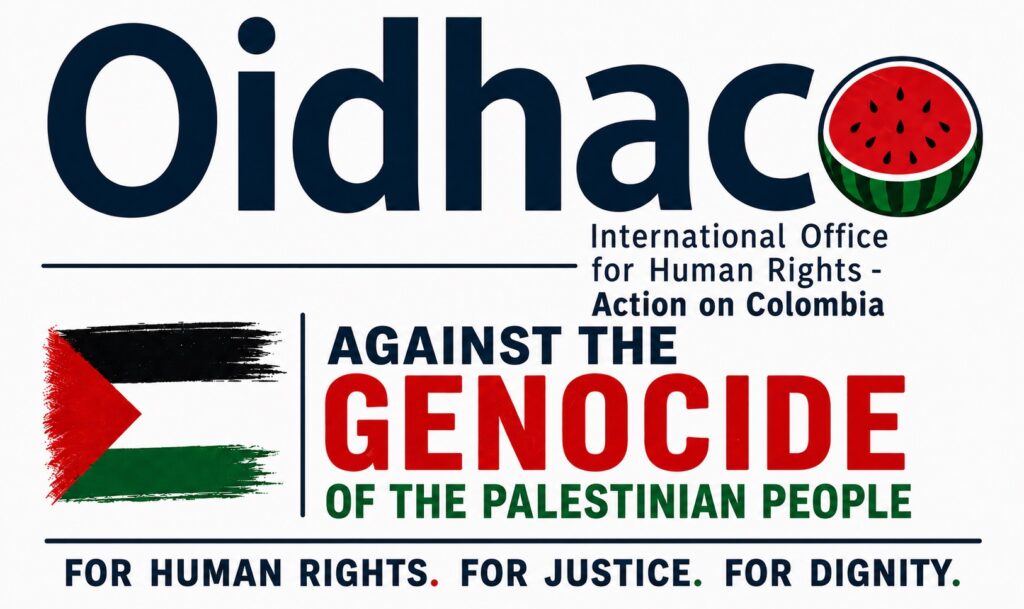
The International Office for Human Rights Action on Colombia

Press release – On International Women’s Day, for victims of the Colombian armed conflict

On International Women’s Day, for victims of the Colombian armed conflict

“The international community should not accept that in a process like the one taking place in Havana, the perpetrators of crimes are more important than the victims. Sexual violence is a crime against humanity and should not be amnestied. The victims are the key to true peace-building and should participate in the talks in Havana. Pushing them side perpetuates a focus on the perpetrators. Countries must therefore insist on the active participation of women’s organisations in the current peace process” says Vincent Vallies, Oidhaco spokesperson.

We call for support from the European Union for women victims of the conflict in Colombia

Oidhaco is deeply concerned by the dramatic situation faced by millions of women victims of armed conflict. Their active participation in the process of building a lasting peace is indispensable.

Colombian women, especially human rights defenders, women in situations of forced displacement, indigenous leaders, small-scale producers and afro-descendant women have been the invisible victims of the armed conflict in Colombia for over five decades. In fact, the “general agreement for ending the conflict and building a stable and lasting peace” between the Colombian government and the FARC does not contemplate any differential gender focus. This is discouraging in terms of the space women will have to participate in the process and whether their proposals will be heard. “Their active participation in the process of building a lasting peace is indispensable. They need the support of the EU”, said Oidhaco spokesperson, Vincent Vallies. Colombia will not find the way to building a lasting peace without the active participation of victims, as MOVICE recalled yesterday on March 6 during the public delivery of its peace proposals.

Our solidarity is universal.

We are deeply concerned about all victims of armed conflict, repression and violence around the world — from Sudan to Syria, including the persecution of the Rohingya and so many other crises that often receive less international attention than they deserve. Each of these situations calls for solidarity, remembrance, justice and action.

However, we have decided to specifically highlight the message ‘Stop Genocide in Palestine’ because what is happening in Palestine represents not only a human tragedy of enormous magnitude, but also a direct challenge to the fundamental principles of international humanitarian law and to the rules-based international system itself. The indifference and complicity of much of the international community in the face of the apartheid regime imposed by the Israeli government on the Palestinian people represent one of the greatest moral and political contradictions of our time.

The persistent violation of essential norms — such as the protection of the civilian population, the prohibition of collective punishment and respect for proportionality in the use of force — not only has devastating consequences for the Palestinian population, but also erodes the global mechanisms designed to limit the power of states and prevent abuses.

When these rules are repeatedly breached without any effective consequences, the framework that protects all populations in conflict situations, anywhere in the world, is weakened. Therefore, speaking out in this case does not mean ignoring other forms of suffering, but rather emphasising the urgency of defending an international order which, if it collapses, leaves everyone in a more vulnerable position.

Drawing attention to this situation is, therefore, an act consistent with the universal values we uphold: the protection of life, human dignity and respect for international law, without exception.

Oidhaco logo - Oficina Internacional de derechos Humanos - Acción Colombia
Privacy Overview

This website uses cookies so that we can provide you with the best user experience possible. Cookie information is stored in your browser and performs functions such as recognising you when you return to our website and helping our team to understand which sections of the website you find most interesting and useful.