The International Office for Human Rights Action on Colombia

Publications: Peacebuilding

Peacebuilding

Assessment of the implementation of point 5 of the Peace Agreement – Agreement on victims of the conflict

The victims of the armed conflict are at the heart of the Peace Agreement signed between the Colombian government and the former FARC-EP. Their active participation in the transitional justice process is indispensable for achieving truth, justice and reparation. That is why the Agreement includes the creation of a Comprehensive System to guarantee their rights

Read more »
Peacebuilding

Assessment of the implementation of point 4 of the Peace Agreement- Voluntary substitution of illicit crops/Solution to the illicit Drug Problem

The Peace Agreement has mechanisms aimed at structurally solving the problem of the production and trafficking of narcotics. The aim is to intervene in the different levels of the drug trafficking chain to comprehensively address this phenomenon (Kroc, 2021: 115). The provisions in point 4 of the Agreement are envisioned as long-term programs, requiring strong

Read more »
Peacebuilding

Assessment of the implementation of point 2 of the Peace Agreement – Political participation

Point 2 of the Peace Agreement aims to modernize and strengthen democracy through mechanisms and measures that guarantee political participation for sectors that are currently underrepresented. Structural reforms are provided for, including guarantees of citizen participation, political-electoral reform, a reform of participatory and democratic planning, and the Special Transitional Peace Constituencies (Kroc, 2021: 18). The

Read more »

New European agenda with Colombia

The socio-economic consequences of the COVID-19 pandemic have deepened pre-existing global inequalities and increased pressure on people in vulnerable situations. This has had a particular impact on human rights and democracy cooperation between the European Union (EU) and Colombia. Although priorities have been redefined, political and financial cooperation for the implementation of the Peace Agreement[1]

Read more »

Members of the EU Parliament send out a letter to Colombian President acknowledging the work done by the Regional Indigenous Council of Cauca (CRIC) and condemning the repression in the context of the National Strike

36 MEPs, of different nationalities and political groups, addressed their concern about the current risks for defenders of the rights of indigenous peoples, afrodescendant communities, small-scale farmers, students, young people and women, especially in regions historically affected by the internal armed conflict, such as the department of Cauca. They call upon the Colombian government to provide

Read more »

The OIDHACO General Assembly requests guarantees for protesters during the National Strike in Colombia and sends alert regarding alleged use of excessive force by the state security forces.

On 28 April, a National Strike began in more than 500 municipalities in Colombia. Convened by the National Strike Committee, this protest brings together several sectors of the population. The protesters are criticizing the government’s tax reform bill, as they believe that it would lead to greater poverty. Moreover, they are protesting about the mismanagement

Read more »

Our solidarity is universal.

We are deeply concerned about all victims of armed conflict, repression and violence around the world — from Sudan to Syria, including the persecution of the Rohingya and so many other crises that often receive less international attention than they deserve. Each of these situations calls for solidarity, remembrance, justice and action.

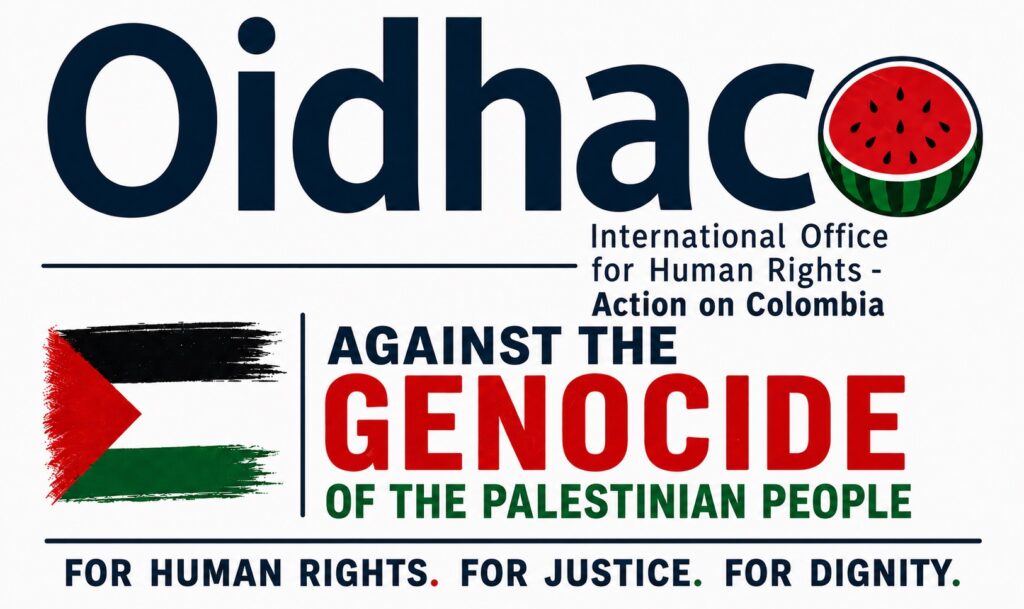
However, we have decided to specifically highlight the message ‘Stop Genocide in Palestine’ because what is happening in Palestine represents not only a human tragedy of enormous magnitude, but also a direct challenge to the fundamental principles of international humanitarian law and to the rules-based international system itself. The indifference and complicity of much of the international community in the face of the apartheid regime imposed by the Israeli government on the Palestinian people represent one of the greatest moral and political contradictions of our time.

The persistent violation of essential norms — such as the protection of the civilian population, the prohibition of collective punishment and respect for proportionality in the use of force — not only has devastating consequences for the Palestinian population, but also erodes the global mechanisms designed to limit the power of states and prevent abuses.

When these rules are repeatedly breached without any effective consequences, the framework that protects all populations in conflict situations, anywhere in the world, is weakened. Therefore, speaking out in this case does not mean ignoring other forms of suffering, but rather emphasising the urgency of defending an international order which, if it collapses, leaves everyone in a more vulnerable position.

Drawing attention to this situation is, therefore, an act consistent with the universal values we uphold: the protection of life, human dignity and respect for international law, without exception.

Oidhaco logo - Oficina Internacional de derechos Humanos - Acción Colombia
Privacy Overview

This website uses cookies so that we can provide you with the best user experience possible. Cookie information is stored in your browser and performs functions such as recognising you when you return to our website and helping our team to understand which sections of the website you find most interesting and useful.