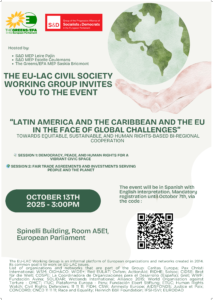
Oidhaco, together with the EU-LAC Civil Society Working Group, is pleased to invite you to the upcoming event at the European Parliament:
A key space to discuss how to strengthen EU–LAC cooperation with a focus on human rights and sustainability.
A key space to discuss how to strengthen EU–LAC cooperation with a focus on human rights and sustainability.
We are delighted to share this news about the National Human Rights Award in Colombia, which is presented by our member Diakonia Sweden and Act Swedish Church with the support of the Swedish Embassy in Colombia. Category: “Defender of the Year” A person whose work over the past year has been a significant testimony to

Below is the statement made by OIDHACO during the 60th session of the Human Rights Council in the interactive dialogue with the Working Group on enforced or involuntary disappearances.

Below is the statement made by OIDHACO during the 60th session of the Human Rights Council in the interactive dialogue with the Special Rapporteur on the promotion of truth, justice, reparation, and guarantees of non-recurrence.

This report, ‘The Challenge of Change: Contention Remains,’ encompasses the third year of the Gustavo Petro administration. Nevertheless, as it has been pertinent in these Reports, it does not aim at an overall balance of the government; it strictly focuseson analysing the Human Rights situation and the responsibility the Colombian State has regarding it. Assessing

470 civil society, trade unions and public interest groups tell President von der Leyen, European Commissioners and EU Member States that our rights, planet, health and justice are not for sale The EU risks a new race to the bottom. Under President Ursula von der Leyen, the European Commission plans an unprecedented wave of drastic

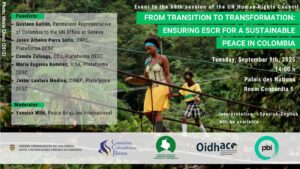
On September 9, within the framework of the 60th session of the United Nations Human Rights Council in Geneva, the side event “From Transition to Transformation: Ensuring ESCR for a Sustainable Peace in Colombia” will take place in Room Concordia 5 at the Palais des Nations (2:00 – 3:00 p.m.). This dialogue space seeks to

We would like to thank MEP Pernando BARRENA for his commitment to human rights and peace in Colombia. From Oidhaco we have positioned ourselves against the existence of a list of safe countries of origin which could be in contradiction with Article 3 of the 1951 Convention Relating to the Status of Refugees. Here is

We would like to thank MEP Isabel Serra Sánchez for her commitment to human rights in Colombia. In May, we at Oidhaco expressed our concern about the situation of risk faced by human rights and environmental defenders in the Jiguamiandó and Curbaradó river basins in the municipality of Carmen del Darién (Chocó), in the Urabá

In this 59th session of the UN Human Rights Council in Geneva, Colombia has been very present. In fact, 4 reports were presented. We would also like to highlight the report on Protection against violence and discrimination based on sexual orientation or gender identity in relation to forced displacement. You can see the first part
We are deeply concerned about all victims of armed conflict, repression and violence around the world — from Sudan to Syria, including the persecution of the Rohingya and so many other crises that often receive less international attention than they deserve. Each of these situations calls for solidarity, remembrance, justice and action.
However, we have decided to specifically highlight the message ‘Stop Genocide in Palestine’ because what is happening in Palestine represents not only a human tragedy of enormous magnitude, but also a direct challenge to the fundamental principles of international humanitarian law and to the rules-based international system itself. The indifference and complicity of much of the international community in the face of the apartheid regime imposed by the Israeli government on the Palestinian people represent one of the greatest moral and political contradictions of our time.
The persistent violation of essential norms — such as the protection of the civilian population, the prohibition of collective punishment and respect for proportionality in the use of force — not only has devastating consequences for the Palestinian population, but also erodes the global mechanisms designed to limit the power of states and prevent abuses.
When these rules are repeatedly breached without any effective consequences, the framework that protects all populations in conflict situations, anywhere in the world, is weakened. Therefore, speaking out in this case does not mean ignoring other forms of suffering, but rather emphasising the urgency of defending an international order which, if it collapses, leaves everyone in a more vulnerable position.
Drawing attention to this situation is, therefore, an act consistent with the universal values we uphold: the protection of life, human dignity and respect for international law, without exception.