The International Office for Human Rights Action on Colombia

Newsletter 15

DAS: Operation Europe Although Colombia’s intelligence services have played an active role in the repression of civil society movements and human rights organisations for several decades now, the creation of the G-3 special group by the DAS

Although Colombia’s intelligence services have played an active role in the repression of civil society movements and human rights organisations for several decades now, the creation of the G-3 special group by the DAS (Administrative Department of Security) in 2004 marked a new departure.  From this date onwards, a systematic policy of phone-tapping, harassment and intimidation began, with its main victims being human rights defenders, Supreme and Constitutional Court judges, journalists and members of the opposition.  Because they were critical of government policies, all of them were treated like dangerous criminals and as a threat to state interests, and thus the subject of relentless persecution.

Newsletter 14

The flaws within the security policy Ever since he began his time in office in 2002, President Uribe’s policy has been to improve the country’s security and to end the armed conflict militarily.

Ever since he began his time in office in 2002, President Uribe’s policy has been to improve the country’s security and to end the armed conflict militarily. During his two terms, he has promoted controversial measures, several of which were found to be unlawful by the Constitutional Court and many of them criticised by the United Nations. They include initiatives such as the network of civilian informants, which involves the civilian population in the armed conflict, in total disregard of the fact that they are protected persons in line with the principle of distinction between combatants and non-combatants, and exposing these people to possible reprisals. This policy of informants as well as the policy of paying civilians rewards for information and soldiers for the detention or killing of members of illegal groups has been responsible for many acts of injustice, including mass arbitrary detentions and, even more seriously, systematic extrajudicial executions.

Newsletter 13

Genuine agrarian counter-reform in Colombia That is how many analysts describe what has been happening in the Colombian countryside in recent decades. A few official statistics are enough to show the extent of the problem.

That is how many analysts describe what has been happening in the Colombian countryside in recent decades.  A few official statistics are enough to show the extent of the problem.  In 1984, 32.7% of the country’s cultivable area was concentrated in the hands of 0.5% of landowners; in 1996, 0.4% of landowners held 44.6% of this area; and, currently, 0.43% of them own 44.6% of cultivable land.  In contrast, 57.87% of landowners own barely 1.66% of the land.  Over the course of 25 years, the armed conflict has been used to increase the concentration of land ownership, Colombia being the country with the second highest number of displaced people in the world, after Sudan.  The displacement of campesinos, indigenous people and Afro-Colombians has not been simply a by-product of the conflict but rather a specific war aim.  In the banana-growing areas of Antioquian Urabá, armed men offered campesinos 250,000 pesos per hectare of land, when the price was four times this figure; those who would not sell up were threatened, suffered extortion and were frequently murdered.  The paramilitary leader known as ‘HH’ admitted to having murdered almost 1,600 people in the region in just two or three years.  Through massacres committed in full view of the population, thousands of people were displaced, with their lands falling into the hands of the killers, or those who succeeded them.  Raúl Emilio Hazbún Mendoza, another paramilitary leader and owner of a banana company, who controlled the region for over 10 years, has admitted to close and longstanding links with the army and the police, with the large landowners and multinationals which had invested in the area under his control.  Chiquita Brands was fined 25 million dollars in the United States for making payments to the paramilitaries, but its directors have never been brought to justice in Colombia.
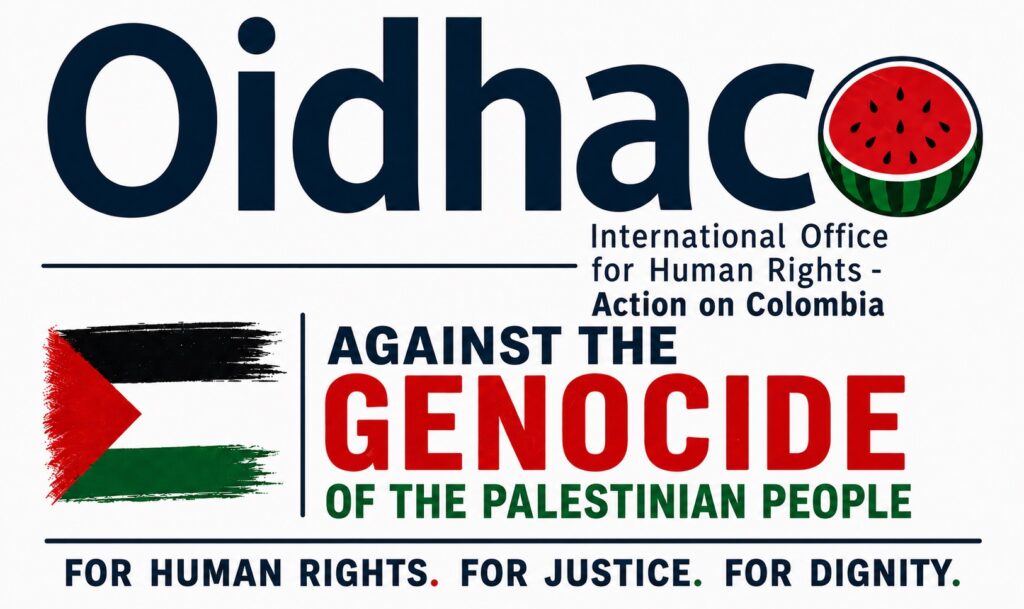
Our solidarity is universal.

We are deeply concerned about all victims of armed conflict, repression and violence around the world — from Sudan to Syria, including the persecution of the Rohingya and so many other crises that often receive less international attention than they deserve. Each of these situations calls for solidarity, remembrance, justice and action.

However, we have decided to specifically highlight the message ‘Stop Genocide in Palestine’ because what is happening in Palestine represents not only a human tragedy of enormous magnitude, but also a direct challenge to the fundamental principles of international humanitarian law and to the rules-based international system itself. The indifference and complicity of much of the international community in the face of the apartheid regime imposed by the Israeli government on the Palestinian people represent one of the greatest moral and political contradictions of our time.

The persistent violation of essential norms — such as the protection of the civilian population, the prohibition of collective punishment and respect for proportionality in the use of force — not only has devastating consequences for the Palestinian population, but also erodes the global mechanisms designed to limit the power of states and prevent abuses.

When these rules are repeatedly breached without any effective consequences, the framework that protects all populations in conflict situations, anywhere in the world, is weakened. Therefore, speaking out in this case does not mean ignoring other forms of suffering, but rather emphasising the urgency of defending an international order which, if it collapses, leaves everyone in a more vulnerable position.

Drawing attention to this situation is, therefore, an act consistent with the universal values we uphold: the protection of life, human dignity and respect for international law, without exception.

Oidhaco logo - Oficina Internacional de derechos Humanos - Acción Colombia
Privacy Overview

This website uses cookies so that we can provide you with the best user experience possible. Cookie information is stored in your browser and performs functions such as recognising you when you return to our website and helping our team to understand which sections of the website you find most interesting and useful.