The International Office for Human Rights Action on Colombia

Newsletter 1

From February 4 to March 6 The march on 4 February in protest at FARC-EP and kidnappings was an important political event, in which a significant proportion of the Colombian population took part.

The march on 4 February in protest at FARC-EP and kidnappings was an important political event, in which a significant proportion of the Colombian population took part. It was a peaceful demonstration targeted fundamentally at one of the parties to Colombia’s internal armed conflict. FARC-EP has been responsible for serious violations of International Humanitarian Law which has, without doubt, caused many Colombians to show their condemnation of this guerrilla group.

Newsletter 3

The Colombian judicial system begins to break through the inertia of impunity For those of us in European countries who are working for the respect of human rights in Colombia, it is very gratifying to see the advances made by the Colombian judicial

It is important to highlight the judicial investigations of soldiers over the massacre in San José de Apartadó (February 2005) and over the disappearances from the Palace of Justice (November 1986). Equally notable are the investigations into the relationship between politicians and paramilitaries – known as ‘parapolitics’ – which have been taken forward by Colombia’s Supreme Court and the Public Prosecutor’s Office.  These have resulted, at the time of writing, in 61 members of Colombia’s Congress being under criminal investigation because of their relationship with paramilitary groups, with 29 of them in prison. The latter include Senator Mario Uribe, nephew and political ally of President Uribe, who was refused asylum by the Costa Rican government.  The fact that many of them, suspected of being responsible for human rights violations, are in police custody, is an additional indicator of the determination to provide justice.

Newsletter 9

Human rights in Colombia under the microscope of the United Nations and European Union Both the follow-up to the conclusions of the Universal Periodic Review of Colombia and the dialogue on human rights between the European Union (EU) and Colombia…

Both the follow-up to the conclusions of the Universal Periodic Review of Colombia and the dialogue on human rights between the European Union (EU) and Colombia offer opportunities to influence policy changes in Bogotá in favour of greater respect for human rights.  We hope that the international community and particularly the EU and its member states will not let this opportunity pass by.

Newsletter 8

Insisting on humanitarian agreements and political negotiation The recent unilateral liberation of 6 people by the FARC-EP is a positive step, made possible by the crucial role played by Colombian civil society.

The recent unilateral liberation of 6 people by the FARC-EP is a positive step, made possible by the crucial role played by Colombian civil society.  It is proof that, in Colombia, humanitarian solutions are possible when humanitarian preoccupations

Newsletter 10

European Union – Colombia free trade treaty: the EU’s prestige at stake The third round of trade negotiations between the EU and the three Andean countries (Colombia, Ecuador, and Peru) was held in Brussels from 4 to 8 May.

The third round of trade negotiations between the EU and the three Andean countries (Colombia, Ecuador, and Peru) was held in Brussels from 4 to 8 May.  These negotiations have, since January 2009, replaced negotiations for an association agreement between the EU and the Andean Community.

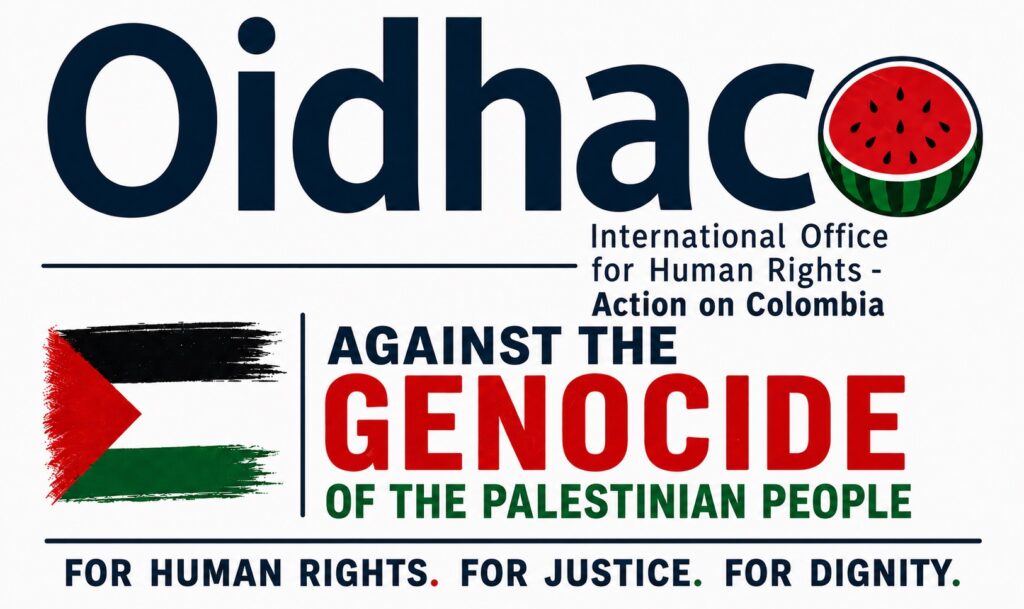
Our solidarity is universal.

We are deeply concerned about all victims of armed conflict, repression and violence around the world — from Sudan to Syria, including the persecution of the Rohingya and so many other crises that often receive less international attention than they deserve. Each of these situations calls for solidarity, remembrance, justice and action.

However, we have decided to specifically highlight the message ‘Stop Genocide in Palestine’ because what is happening in Palestine represents not only a human tragedy of enormous magnitude, but also a direct challenge to the fundamental principles of international humanitarian law and to the rules-based international system itself. The indifference and complicity of much of the international community in the face of the apartheid regime imposed by the Israeli government on the Palestinian people represent one of the greatest moral and political contradictions of our time.

The persistent violation of essential norms — such as the protection of the civilian population, the prohibition of collective punishment and respect for proportionality in the use of force — not only has devastating consequences for the Palestinian population, but also erodes the global mechanisms designed to limit the power of states and prevent abuses.

When these rules are repeatedly breached without any effective consequences, the framework that protects all populations in conflict situations, anywhere in the world, is weakened. Therefore, speaking out in this case does not mean ignoring other forms of suffering, but rather emphasising the urgency of defending an international order which, if it collapses, leaves everyone in a more vulnerable position.

Drawing attention to this situation is, therefore, an act consistent with the universal values we uphold: the protection of life, human dignity and respect for international law, without exception.

Oidhaco logo - Oficina Internacional de derechos Humanos - Acción Colombia
Privacy Overview

This website uses cookies so that we can provide you with the best user experience possible. Cookie information is stored in your browser and performs functions such as recognising you when you return to our website and helping our team to understand which sections of the website you find most interesting and useful.