The International Office for Human Rights Action on Colombia

Peacebuilding

What we do

Peacebuilding

Peacebuilding

According to the International Committee of the Red Cross, five internal armed conflicts are occurring in Colombia simultaneously. These disproportionately affect indigenous, Afro-Colombian, peasant and other rural communities, and women, children and LGBT people. The conflict has produced around 9 million victims, and violations of International Humanitarian Law have been committed by all the armed actors involved in the conflict.

Despite the widespread persecution and violence, civil society in Colombia is very active and continues to play a fundamental role in the promotion of a negotiated end to the conflict and the construction of peace with social justice. Oidhaco believes in a negotiated end to the armed conflict and in the role of civil society in the construction of peace. For this reason, we have accompanied civil society initiatives and encouraged dialogue with the European Union and member- and other European states in an attempt to encourage understanding and garner support.

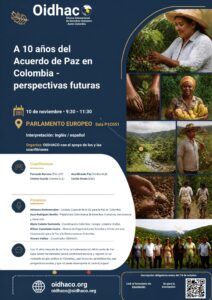
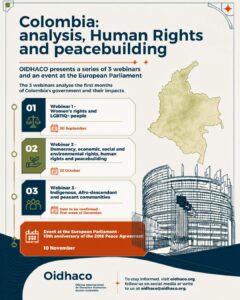
In 2016, the Colombian state and the Fuerzas Armadas Revolucionarias de Colombia (FARC-EP) signed a Peace Accord, which was supported by Colombian and international civil society and by a range of European governments and multilateral bodies, including the United Nations. The Accord acknowledged the structural factors that led to the Colombian armed conflict and included measures on  comprehensive rural reform and agricultural development; the reincorporation of former combatants; political reforms to deal with the problem of narcotics and drugs’ trafficking;  the broadening of political participation; and reparation for the victims of the armed conflict. 

However, the internal armed conflict and the humanitarian crisis in Colombia did not end with the signing of the Peace Accord, which has not been implemented in its entirety. Other illegal armed groups maintain their presence in the rural areas, carrying out attacks that have a disproportionate effect on ethnic and rural populations.

Given this panorama, Oidhaco argues that the European Union, its member- and other European states and the United Nations system should support and monitor the implementation of the comprehensive Peace Accord, ensure that international cooperation resources  are deployed transparently to fund agreements included in the Accord and that the states providing finance should monitor the way it is spent permanently.

In addition, Oidhaco draws attention to the effects on the civilian population of the persistent armed conflict; it advocates for a negotiated resolution, in particular for dialogue with the largest remaining guerrilla group the Ejército de Liberación Nacional (ELN) and the effective dismantlement of paramilitarism. It highlights the effects of the Colombian government’s defence and security policies on the situation of human rights and International Humanitarian Law,  the closure of spaces for civil society, the implementation of the Peace Accord and peace building in the rural territories.

Related posts: Peacebuilding

Our solidarity is universal.

We are deeply concerned about all victims of armed conflict, repression and violence around the world — from Sudan to Syria, including the persecution of the Rohingya and so many other crises that often receive less international attention than they deserve. Each of these situations calls for solidarity, remembrance, justice and action.

However, we have decided to specifically highlight the message ‘Stop Genocide in Palestine’ because what is happening in Palestine represents not only a human tragedy of enormous magnitude, but also a direct challenge to the fundamental principles of international humanitarian law and to the rules-based international system itself. The indifference and complicity of much of the international community in the face of the apartheid regime imposed by the Israeli government on the Palestinian people represent one of the greatest moral and political contradictions of our time.

The persistent violation of essential norms — such as the protection of the civilian population, the prohibition of collective punishment and respect for proportionality in the use of force — not only has devastating consequences for the Palestinian population, but also erodes the global mechanisms designed to limit the power of states and prevent abuses.

When these rules are repeatedly breached without any effective consequences, the framework that protects all populations in conflict situations, anywhere in the world, is weakened. Therefore, speaking out in this case does not mean ignoring other forms of suffering, but rather emphasising the urgency of defending an international order which, if it collapses, leaves everyone in a more vulnerable position.

Drawing attention to this situation is, therefore, an act consistent with the universal values we uphold: the protection of life, human dignity and respect for international law, without exception.

Oidhaco logo - Oficina Internacional de derechos Humanos - Acción Colombia
Privacy Overview

This website uses cookies so that we can provide you with the best user experience possible. Cookie information is stored in your browser and performs functions such as recognising you when you return to our website and helping our team to understand which sections of the website you find most interesting and useful.